
Cybersecurity as the New Frontline: State-Sponsored Hacks and Global Digital Defense Pacts
Recent intrusions into critical infrastructure have seen a significant rise, with 40% linked to nation-states. This is double the rate from just two years ago. Each incident now costs an estimated $1.6 million, highlighting the growing concern. The Russo-Ukrainian war has shown how cyberattacks are becoming more integrated into traditional warfare. This shift is redefining how nations prepare for future crises.
This case study emphasizes Cybersecurity as the New Frontline for the United States and its allies. It explores how cyber threats have evolved from stealthy espionage to persistent campaigns against key sectors. China, Russia, North Korea, and Iran are using APT units for espionage, disruption, and profit, often in the same operation.
Joint advisories from various international agencies highlight the PRC-linked Volt Typhoon campaign. These alerts detail living-off-the-land tactics, valid-account abuse, and long-term persistence in U.S. networks. The urgency of these threats demands swift action and global cooperation.
Global digital defense pacts are essential to counter these threats. Technical attribution must be complemented by legal frameworks for accountability. This article connects historical cyberattacks like Stuxnet and Sony Pictures to today’s pressing cybersecurity challenges. It outlines how alliances can effectively counter state-sponsored hacks before they cause real-world damage.
Key Takeaways
- Nation-state targeting of critical infrastructure has doubled, marking Cybersecurity as the New Frontline for allied defense.
- Average incident costs are estimated at $1.6 million, elevating cyber threats to boardroom and national security priorities.
- China, Russia, North Korea, and Iran use APT tactics that mix espionage, disruption, and monetization.
- Global digital defense pacts and joint advisories accelerate detection of living-off-the-land techniques.
- Legal frameworks for attribution strengthen deterrence and support credible accountability.
- Historical attacks from Stuxnet to Mirai inform today’s cybersecurity trends and readiness.
- Allied coordination is essential to protect energy, water, transportation, and communications from state-sponsored hacks.
Executive Summary: The Surge in State-Sponsored Cyber Threats Across Critical Infrastructure
Global cybersecurity trends are rapidly evolving, with nation-state groups intensifying their attacks on critical sectors like power, transport, and healthcare. This escalation has prompted leaders to consider implementing new measures to bolster online security within the U.S. and its allies’ critical infrastructure.
Doubling of nation-state targeting of critical infrastructure from 20% to 40%
Recent data reveals a significant increase in hostile activities against critical infrastructure, jumping from 20% to 40% in just two years. This trend highlights a shift towards more sophisticated and stealthy cyber attacks, which expand the attack surface and intensify cyber threats to online security.
Average organizational cost per incident estimated at $1.6 million
The average cost of a cyber incident has surged to $1.6 million, driven by various factors including business disruption, response efforts, legal expenses, and the cost of rebuilding. This figure emphasizes the substantial financial risks that cyber threats pose to organizations, underscoring the need for robust security measures to protect online security and fortify critical infrastructure against evolving cybersecurity trends.
Geopolitical conflicts amplifying cyber warfare and cyberweapons use
Escalating global conflicts have normalized the use of digital strike tools and the strategic positioning of cyber weapons. The ongoing conflict between Russia and Ukraine exemplifies how quickly tactics are disseminated, elevating the baseline risk. This scenario demands that defenders continually adapt to advanced cyber threats, ensuring the protection of critical infrastructure and maintaining online security in alignment with the latest cybersecurity trends.
Historical Context: From Early Cyber Espionage to a Global Security Imperative
The history of cyber espionage reflects the growth of networked power. Initial hacks were small and discreet but laid the groundwork for today’s cybersecurity landscape. They influenced the information security protocols used by governments and corporations.
A brief thread runs from analog spycraft to digital reach. As systems expanded across borders, small breaches grew into larger issues. The stakes escalated with each new platform and dependency.
1980s origins: Farewell Dossier, Chaos Computer Club, and early digital espionage
In the 1980s, France’s “Farewell Dossier” and the Chaos Computer Club showed how computers could be used for intelligence and testing defenses. These events marked a significant shift in cyber espionage history, foreshadowing today’s cybersecurity trends.
They also highlighted the need for stronger information security protocols as the West and East competed to exploit emerging networks.
Evolution into a potent tool affecting political, economic, and societal domains
By the 2000s, campaigns like Titan Rain and APT1’s activities pushed intrusions into defense and high-tech sectors. The DNC hack debates and ODNI statements revealed how influence operations could shape public discourse.
Stuxnet targeted nuclear systems, the Sony Pictures breach shocked entertainment, and the Estonia DDoS and Mirai botnet stressed core internet services. These incidents drove the need for sharper information security protocols and reshaped cybersecurity trends across industries.
From targeted intrusions to systemic risks in a hyperconnected world
Global supply chains, cloud platforms, and shared software components turned local incidents into global shocks. A compromise in one region can disrupt partners and customers elsewhere, intensifying the study of cyber espionage history for clues to resilience.
Legal debate also evolved. Beyond technical forensics, attribution now weighs circumstantial patterns and procedural standards, echoing how courts evaluate responsibility. This shift influences how organizations adopt information security protocols and track emerging cybersecurity trends.
| Milestone | Primary Domain Impacted | Notable Effect | Security Response Pattern |
|---|---|---|---|
| Farewell Dossier (1980s) | Intelligence | Exposed strategic tech theft pathways | Early emphasis on insider controls and audit trails |
| Chaos Computer Club actions (1980s) | Government/Research | Revealed vulnerabilities in public systems | Push for transparency and baseline information security protocols |
| Titan Rain (2000s) | Defense/High-Tech | Sustained, state-linked intrusions | 24/7 monitoring and incident response playbooks |
| APT1 reporting (2013) | Commercial/Industrial | Attribution shaped policy debate | Threat intelligence sharing and red-teaming |
| Stuxnet | Industrial Control Systems | Physical effects via malware | IT/OT segmentation and specialized detection |
| Estonia DDoS | Government/Citizen Services | Service disruption at national scale | DDoS mitigation and resilient DNS design |
| Sony Pictures breach | Media/Entertainment | Data theft and intimidation | Hardening endpoints and rapid comms planning |
| Mirai botnet | Internet Infrastructure | IoT-enabled outages | Secure defaults and device lifecycle governance |
Threat Actor Landscape: China, Russia, North Korea, and Iran as Persistent APT Adversaries
State-backed campaigns dominate today’s cyber threats. China, Russia, North Korea, and Iran have APT adversaries backed by funding, training, and support. This enables them to maintain long dwell times and target precisely. Their actions put pressure on data protection in both public agencies and private sectors, leading leaders to invest in advanced cybersecurity solutions.
These actors use telecom routes, cloud services, and managed service providers to blend in with normal traffic. They prefer quiet entry, strong operational security, and tactics like living-off-the-land, DNS hijacking, and supply-chain access. This approach allows them to remain stealthy, scale their operations, and reach across continents.
Why well-funded, specialized nation-state actors prioritize high-value targets
High-value targets offer leverage and intelligence. Defense ministries, energy grids, and telecom backbones provide broad insight into policy, military posture, and crisis response. Universities and think tanks offer early access to research and strategy papers, while government networks contain credentials and sensitive policy data.
With state resources, these APT adversaries can run multi-year operations, rotate infrastructure, and test zero-days. This raises the bar for data protection and demands layered cybersecurity solutions that detect low-noise behaviors, not just malware signatures.
Blurring lines between APTs and cybercrime for revenue and disruption
The boundary between espionage and profit is thin. North Korea’s Lazarus and BlueNoroff have pursued cryptocurrency theft to finance operations. Russia-linked groups such as APT28 and APT29 mix intelligence collection with supply-chain compromises that create downstream impact.
China-focused clusters have leveraged telecom access and provider routes to intercept traffic, while Iran’s APT33, APT34, APT35, and MuddyWater blend credential theft with destructive tooling and DNS tunneling. This fusion drives new cyber threats and complicates response playbooks built for either crime or espionage alone.
Implications for defense, energy, telecom, higher education, and government
Defense faces persistent targeting of logistics, satellite links, and contractor ecosystems. Energy operators must prepare for intrusions that move from IT into industrial systems. Telecom carriers confront attempts to monitor or reroute traffic, threatening confidentiality and service continuity.
Higher education endures theft of research and access to partner networks. Federal, state, and local agencies manage sustained credential abuse and covert lateral movement. Meeting this pressure requires cybersecurity solutions aligned to mission risk: identity security, network segmentation, anomaly detection, and rapid containment that protect data protection goals while keeping services online.
China Focus: PRC APTs, LOTL Tradecraft, and the Volt Typhoon Critical Infrastructure Campaign

U.S. agencies and allies now see cybersecurity as a critical frontline, protecting power grids, pipelines, and telecom hubs. PRC-linked groups have perfected living-off-the-land tactics, making it essential to rethink online security. This requires tightening network security measures with effective internet strategies.
ODNI assessments on PRC capability to disrupt U.S. critical services
The 2023 Annual Threat Assessment from the Office of the Director of National Intelligence warns of the PRC’s capability to disrupt U.S. critical services. It highlights risks to oil and gas pipelines and rail systems. Cybersecurity is now a frontline for operators reliant on connected control networks.
CISA, NSA, FBI, DOE, EPA, TSA, ASD/ACSC, CCCS/CSE, NCSC-UK, and NCSC-NZ have issued advisories. They emphasize the importance of disciplined online security and layered network measures. Targeted internet strategies for operational technology are also stressed.
Volt Typhoon’s living-off-the-land techniques and long-term persistence
Volt Typhoon uses command-line operations, native binaries, and commercial tools after gaining network access. The group rarely uses custom malware, which helps evade endpoint controls. Their persistence can last years, making it challenging for defenders to detect subtle changes.
Teams must enrich logs, map privileges, and validate host behavior to counter Volt Typhoon’s tactics. This approach integrates internet security strategies into daily operations. It ensures online security without hindering operations.
Targeting via VPN, valid accounts, and Active Directory compromise
Initial access often comes through public-facing appliances from Fortinet, Ivanti Connect Secure, NETGEAR, Citrix, and Cisco. A documented case involved CVE-2022-42475 on a FortiGate 300D. Operators then use VPNs, harvest admin credentials, and pivot with RDP to expand control.
They aim for domain dominance by extracting NTDS.dit, cracking password hashes offline, and seizing Active Directory. Once privileged, they can stage access to OT networks. Defenders should harden identity paths and enforce network security measures like segmentation and just-in-time admin access to sustain online security.
Case studies: APT10, APT17, APT41, Aoqin Dragon, WIP19, Operation Tainted Love
APT10 has targeted healthcare, defense, and aerospace with managed service provider abuse. APT17 is linked to Operation Aurora and the CCleaner compromise, showing a reach from source code to supply chains. APT41 blends espionage and financial crime, striking both public and private networks.
Aoqin Dragon favors document exploits and DNS tunneling to bypass filters. WIP19 has used stolen certificates and tools such as SQLMaggie and ScreenCap for stealth. Operation Tainted Love hit telecom operators, highlighting how data and signaling routes become high-value terrain in cybersecurity as the new frontline.
Across these campaigns, LOTL, DNS and HTTP hijacking, and a focus on security and virtualization tools recur. Agencies recommend baselining, SIEM correlation, and IDS tuning for ICS, anchored by secure-by-design practices. These internet security strategies support resilient online security and reinforce network security measures where it counts most.
Russia Focus: From Moonlight Maze to SolarWinds—Espionage, Influence, and Infrastructure Targeting
Russian operators have evolved from the Moonlight Maze in the late-1990s to the SolarWinds compromise. They have mastered long-haul espionage, covert influence, and probes against critical systems. Organizations in the United States face persistent cyber threats that test their data protection, online security, and the rigor of their information security protocols.
APT28, APT29, Turla, Sandworm, and Gamaredon Evolution
Turla’s lineage goes back to Moonlight Maze, showing patient tradecraft and stealthy exfiltration. APT28, tied to the GRU, pursues fast-moving operations. APT29, linked to the SVR, favors quiet access and staged credential theft. Sandworm and Gamaredon add disruption and rapid tasking, widening the threat profile that challenges online security and data protection across public and private networks.
These groups mix zero-day exploitation, living-off-the-land techniques, and themed lures. COVID-19 narratives, diplomatic events, and software updates have all been used to bypass information security protocols and expand reach.
Supply Chain Compromises and Election Interference as Strategic Tools
APT29’s role in the 2021 SolarWinds incident underscored how a single vendor breach can ripple across agencies and Fortune 500 firms. Earlier, the CozyDuke toolset was observed in the 2014 White House intrusion, highlighting long-term access and credential pivoting that strain online security baselines.
Election interference activities, reported by U.S. intelligence in 2016 and seen through the 2022 midterms, rely on hacked-and-leaked material, influence seeding, and targeted phishing. These methods demand stronger supplier vetting, tamper-evident builds, and attribution-ready logging that support data protection goals.
HermeticWiper, Snake Implant, and Industrial Control Systems Risk
Sandworm-aligned operations have deployed destructive malware, including HermeticWiper, which corrupted master boot records at Ukrainian organizations to trigger boot failure. The Snake implant, attributed to the FSB, operated in more than 50 countries for long-term intelligence collection, pressuring defenders to harden endpoints and segment sensitive data.
Russian units have also scoped underwater cables and industrial control systems. This activity raises risk for energy, telecom, and transport operators and tests information security protocols meant to isolate safety systems while maintaining cyber threats monitoring and online security across IT and OT.
North Korea Focus: Lazarus, BlueNoroff, and Financially Motivated Cyber Operations
North Korea’s cyber ecosystem combines espionage with large-scale theft. Its operators test defenses, use third parties, and move funds secretly. For U.S. defenders, strong online security and careful third-party oversight are key to reducing exposure.
Financial gains now drive much of the activity, while stealth and patience mark the tradecraft. Teams adapt to new controls quickly, using living-off-the-land methods and cloud abuse. Effective cybersecurity solutions must track behavior, not just malware signatures, to curb fast-changing cyber threats.
From Sony and WannaCry to global cryptocurrency heists
The Lazarus Group, active for over a decade, hit Sony Pictures in 2014 and unleashed WannaCry in 2017. After sanctions tightened, they shifted toward crypto theft and bank fraud. BlueNoroff targeted banks and SWIFT-linked infrastructure, exploiting gaps in payment controls.
Investigators later tied Lazarus to TrickBot activity in 2019, showing links to criminal networks. This broadened reach sped up laundering and cash-out cycles. Guarding digital privacy and funds now demands anomaly-based monitoring across wallets and exchanges.
Supply chain targeting and collaborations with cybercrime groups
North Korean units probe software vendors, managed service providers, and cloud platforms. Partnerships with crimeware crews help them rent access, scale phishing, and mask flows of stolen assets. Such moves heighten cyber threats by turning trusted updates into delivery paths.
Security leaders should harden build systems, verify artifacts, and enforce signed releases. Balanced online security includes identity proofing, zero-trust checks, and continuous validation of third-party access. These cybersecurity solutions slow lateral movement and reduce blast radius.
Recent intrusions: ScarCruft, Kimsuky, and JumpCloud
ScarCruft and Lazarus were reported breaching Russia’s NPO Mashinostroyeniya using the OpenCarrot backdoor. Kimsuky deployed ReconShark to map targets across Asia, North America, and Europe. A separate incident at JumpCloud underscored how cloud and MSP pathways can seed broad compromise.
Defenders benefit from rapid intel sharing and strict partner governance. Track zero-day exposure, enforce MFA for admins, and monitor for odd token use. Align controls with digital privacy principles to protect data as it moves across services, clients, and brokers.
- Financial focus: Crypto-asset monitoring, SWIFT workflow validation, and clawback playbooks.
- Supply chain: Signed builds, SBOM checks, and vendor risk scoring tied to access tiers.
- Detection: Behavior analytics for living-off-the-land activity and cloud identity drift.
- Resilience: Segmented backups, key rotation, and cross-team drills for payment fraud.
When teams align cybersecurity solutions with payment security and identity controls, they gain ground. Clear playbooks and tested response steps make online security more durable, even as tactics shift. The goal is to narrow dwell time while safeguarding digital privacy across every partner link.
Iran Focus: Espionage to Destructive Operations Across Energy and Telecom
Iranian operators have shifted from stealthy data collection to aggressive campaigns targeting refineries, grids, and carriers. They quickly adapt, combining custom loaders with open-source tools. This allows them to pivot through cloud services, hiding their traffic. In response, defenders in the United States focus on internet security strategies and information security protocols. These efforts aim to reduce dwell time and limit the impact of attacks.
Historic lessons continue to shape today’s tactics. The Shamoon wiper attacks against Saudi Aramco and RasGas set a precedent for destructive intent. Despite the evolution of network security measures, the tradecraft has kept pace with rapid vulnerability exploitation and stealthy persistence.
APT33, APT34, MuddyWater, and APT35 tactics and campaigns
APT33 (Elfin) and APT34 (OilRig) employ spearphishing, password spraying, and supply chain access in the energy and telecom sectors. MuddyWater, linked to Iran’s Ministry of Intelligence and Security, uses open-source malware and script-based loaders to evade detection. APT35 (Charming Kitten) combines phishing with lure sites, utilizing cloud mail and storage for data movement.
These groups frequently change their infrastructure, reuse themes across regions, and quickly adapt after being disrupted by Microsoft, Google, and Meta. Effective internet security strategies include least privilege, identity hardening, and resilient logging across endpoints and cloud control planes.
Use of domain spoofing, social engineering, and cloud C2
Operators spoof domains resembling Microsoft 365, Google Workspace, and telecom portals to steal credentials. They exploit current events and policy briefs to drive clicks. Cloud-based command-and-control blends with normal traffic, forcing defenders to enrich telemetry and apply granular information security protocols.
To mitigate risk, network security measures such as DNS filtering, MFA enforcement, and conditional access policies are implemented. These are complemented by anomaly detection in email, identity, and SaaS audit logs. These steps restrict lateral movement and disrupt long-term persistence.
Timely exploitation of Log4j/ProxyShell and DNS tunneling
The TunnelVision cluster demonstrated the swift exploitation of newly disclosed flaws—Log4j and ProxyShell. Once inside, operators favor DNS tunneling for data exfiltration and command staging, avoiding common IDS alerts. Patch orchestration and authenticated scanning reduce exposure windows.
Security teams align internet security strategies with rapid CVE triage, while information security protocols mandate change control and rollback plans. Combined with network security measures like egress controls and DNS analytics, these practices curb attacker freedom of movement.
| Actor/Cluster | Primary Techniques | Targets | Notable Tradecraft | Defensive Priorities |
|---|---|---|---|---|
| APT33 (Elfin) | Spearphishing, password spraying, malware droppers | Energy suppliers, aviation, industrial firms | Operational technology adjacency and staging for wipers | Identity protection, endpoint isolation, internet security strategies for OT-IT boundaries |
| APT34 (OilRig) | Credential theft, web shells, supply chain access | Telecom carriers, regional energy entities | Custom implants with living-off-the-land techniques | Segmentation, secret rotation, information security protocols for third parties |
| MuddyWater (TA450) | Open-source malware, scripts, DNS tunneling | Government, energy, technology services | Frequent infrastructure changes to evade blocking | DNS monitoring, egress rules, network security measures with behavior analytics |
| APT35 (Charming Kitten) | Phishing, domain spoofing, cloud C2 | Policy orgs, academia, media, telecom | Use of lure sites and cloud mail for staging | MFA, conditional access, internet security strategies for SaaS hardening |
| TunnelVision | Rapid Log4j/ProxyShell exploitation | Public-facing apps in energy and services | Fast weaponization of fresh CVEs | Patch orchestration, continuous scanning, information security protocols for change control |
Counting the Cost: Sector, Economic, and Geopolitical Impacts of State Attacks

State-backed operations now significantly influence budgets, policy, and trust levels. As cyber threats escalate, organizations face a delicate balance between protecting data and fulfilling their missions. This balance is further complicated by the need to maintain digital privacy while ensuring transparency. The consequences of these attacks are evident in various sectors, including healthcare, manufacturing, and election systems. These sectors reflect the rapid evolution of cybersecurity trends across the United States.
Healthcare and Public Safety Disruptions During the COVID-19 Era
Ransomware and espionage campaigns during the pandemic put immense strain on healthcare delivery and vaccine research. North Korean crews employed extortion tactics, causing delays in surgeries and ambulance diversions.
Hospitals responded by strengthening data protection and triage protocols. Despite these efforts, recovery times extended. These incidents highlighted the need for enhanced digital privacy for patients and exposed weaknesses in incident command systems.
Billions Lost to IP Theft and Supply Chain Compromise
Quarterly economic losses mount as proprietary designs, pharmaceutical formulas, and defense technology are stolen and leaked abroad. U.S. assessments attribute a significant portion of these losses to Chinese cyber espionage. DPRK cryptocurrency heists have also contributed to the financial damage.
The SolarWinds breach, affecting thousands of networks including federal agencies, underscored the risk of trusted updates. Companies now focus on tracking cybersecurity trends in vendor access, zero trust, and attestations to fortify data protection from end to end.
Election Interference and Critical Infrastructure Jeopardy
Russian influence operations and intrusions, spanning from 2016 to 2022, have eroded confidence in democratic processes. Disinformation campaigns combined with breaches to test social cohesion and digital privacy norms.
Attacks on industrial control systems and even underwater cables have heightened contingency planning efforts. Guidance from CISA and NIST emphasizes minimum controls as cyber threats evolve. This includes rapid intelligence sharing and establishing clear accountability paths.
Attribution as Strategy: Building a Legal Framework for Identifying State Responsibility
Attribution transforms technical data into enforceable law. It bridges forensic analysis with legal norms, guiding policy, budget, and diplomacy. Successful cases also inform security protocols and shape cybersecurity solutions across various sectors.
Legal scholars, including Delbert Tran in the Yale Journal of Law & Technology, highlight the need for sufficient proof, not absolute certainty. This perspective aligns with current cybersecurity trends. Here, multiple indicators—such as network logs, malware lineage, and infrastructure reuse—support reasoned judgments.
From technical footprints to legally sufficient standards of proof
Cases like Stuxnet, the Sony Pictures breach, and the DNC intrusion demonstrate how cumulative evidence builds compelling narratives. Chain-of-custody, peer review, and red-team challenges enhance these narratives for court use while maintaining online security.
To safeguard sensitive information, procedures might use summaries, in-camera review, or classified annexes. Robust information security protocols ensure evidence integrity from collection to presentation. Vetted cybersecurity solutions also verify exhibits without revealing tradecraft.
Adversarial vs. inquisitorial models and evidentiary production
An adversarial model focuses on party-driven proof and cross-examination. In contrast, an inquisitorial model empowers the tribunal to gather and test evidence. Both models can be adapted to manage classified information and uphold due process.
Discovery limits, protective orders, and special advocates help balance transparency with risk. These measures reflect current cybersecurity trends and enhance online security by preventing disclosure of exploit methods.
State responsibility doctrines for non-state actors and proxies
International law permits attribution when a state directs, controls, or acknowledges a proxy’s actions. Patterns in tasking, infrastructure, and funding can meet the threshold when aligned with operational timelines.
Rigorous logging, tamper-evident storage, and shared hashes under common protocols strengthen the evidence record. Coordinated cybersecurity solutions enable allies to compare indicators without exposing sensitive tooling.
Pathways to an international tribunal or hybrid dispute mechanisms
Potential venues include the International Court of Justice to WTO-style panels and mass claims commissions modeled on the U.S.–Iran Tribunal. Hybrid designs could offer faster remedies tailored to cyber harms.
Options include standing technical chambers, expert rosters, and expedited relief for critical infrastructure. Such designs reflect evolving cybersecurity trends while ensuring online security through controlled evidence handling.
Cybersecurity as the New Frontline

Cybersecurity has become the new frontline, marking a significant shift in national risk. A decade ago, former Director of National Intelligence James Clapper ranked cyber threats above terrorism. Today, we see this reality in the constant pressure faced by power grids, cloud platforms, and university networks from state-backed operators.
Adversaries are probing the very fabric of our daily lives. They target communications backbones, transportation systems, water utilities, and government IT. Many gain entry through suppliers and managed service providers, hiding in plain sight during routine maintenance.
Campaigns like Volt Typhoon demonstrate how stealthy attacks can be. By using native tools and valid accounts, intruders blend in, reducing logs and evading detection. These footholds can persist for years, turning into leverage during critical moments.
Destructive malware and influence operations around elections highlight the stakes. In this context, internet security strategies must focus on secure-by-design engineering, joint advisories, and rapid sector collaboration. A credible path to attribution is also essential.
Clear standards help deter states and proxies, protecting civilian infrastructure. These needs are shaping cybersecurity trends across various sectors, including utilities, healthcare, telecom, and higher education.
For security leaders, the task is pragmatic: align detection, response, and procurement with this frontline reality, while sustaining trust in core services.
| Frontline Pressure Point | Observed Tactic | Operational Need | Outcome Sought |
|---|---|---|---|
| Critical Infrastructure (Energy, Water, Transport) | Living-off-the-land, valid-account abuse, long-term persistence | Behavior analytics, privileged access controls, network segmentation | Reduce dwell time and contain lateral movement |
| Communications and Cloud Backbones | Supply chain access via MSPs and firmware management | Vendor assurance, signed updates, continuous posture monitoring | Integrity of core services and rapid rollback capability |
| Higher Education and Research | Credential phishing and data exfiltration at scale | MFA everywhere, data loss prevention, identity threat detection | Protect IP while enabling open collaboration |
| Public Sector and Elections | Wiper malware, influence operations, infrastructure probing | Incident playbooks, verified communications, backup resilience | Service continuity and public confidence |
| Enterprise Supply Chains | Trusted tool abuse and covert update channels | SBOM requirements, code-signing validation, anomaly alerts | Transparent builds and faster compromise isolation |
As organizations refine their internet security strategies, they track cybersecurity trends that elevate resilience. These include secure defaults, threat-informed defense, and cross-border information sharing. Cybersecurity as the New Frontline sets the frame for these choices and the urgency behind them.
Global Digital Defense Pacts: Toward Collective Deterrence and Faster Threat Sharing
Allied agencies now collaborate to combat stealthy intrusions and expedite alerts. These global digital defense pacts focus on practical guidance, swift intelligence exchange, and clear norms to protect civilian systems. They combine cybersecurity solutions with disciplined network security measures to enhance online security across various sectors.
Recently, CISA, the NSA, and the FBI joined forces with Five Eyes partners and sector regulators. They issued joint advisories to highlight living-off-the-land activity in critical networks. The alerts pointed out multi-sector compromises tied to Volt Typhoon and urged immediate mitigations. CISA Director Jen Easterly emphasized that observed intrusions are just the beginning, urging owners and operators to report and adopt published guidance.
Joint advisories by CISA, NSA, FBI with Five Eyes and allied partners
CISA, NSA, FBI, DOE, EPA, and TSA issued coordinated bulletins. These align with ASD/ACSC in Australia, CCCS/CSE in Canada, NCSC-UK, and NCSC-NZ. The bulletins provide actionable indicators, LOTL tradecraft details, and sector-specific steps. This collaboration enables faster threat sharing, strengthening cybersecurity solutions and keeping online security at the forefront.
Operational collaboration for LOTL detection and incident response
Allies advocate for baselining host and network behavior, SIEM correlation across IT and OT, and IDS alerts for ICS anomalies. They refine response playbooks that track VPN exploit paths and valid-account abuse, including AD and NTDS.dit targeting. These measures help defenders detect quiet persistence and reduce dwell time.
Norms and agreements discouraging attacks on civilian infrastructure
Partners outline expectations to shield hospitals, utilities, and transport from state-driven cyber harm. Joint statements support a rules-based order and advocate for the CISA/NIST Cybersecurity Performance Goals as a minimum. By linking global digital defense pacts to practical benchmarks, agencies foster consistent safeguards and measurable online security outcomes.
| Agency/Partner | Core Contribution | Operational Focus | Outcome for Defenders |
|---|---|---|---|
| CISA (United States) | Guidance and sector coordination | Baseline controls; cross-sector alerts | Adoption of cybersecurity solutions aligned to CPGs |
| NSA (United States) | Signals intelligence insights | LOTL TTPs; lateral movement patterns | Sharper detection of stealth activity |
| FBI (United States) | Investigation and victim engagement | Incident reporting; evidence preservation | Faster attribution support |
| ASD/ACSC (Australia) | Threat sharing and advisories | VPN exploits; credential abuse | Actionable indicators for network security measures |
| CCCS/CSE (Canada) | National risk guidance | OT monitoring; ICS anomaly flags | Improved OT visibility |
| NCSC-UK (United Kingdom) | Best-practice frameworks | AD hardening; segmentation | Reduced blast radius |
| NCSC-NZ (New Zealand) | Regional surge support | Hunt operations; log triage | Lower mean time to detect |
| DOE, EPA, TSA (United States) | Sector oversight | IT/OT path reviews; incident drills | Resilient critical infrastructure |
Key takeaway for practitioners: Align to CISA/NIST goals, prioritize LOTL hunting, and participate in trusted sharing channels. This layered approach integrates cybersecurity solutions into daily operations, elevates online security, and amplifies the impact of global digital defense pacts.
Defense in Depth: Information Security Protocols and Internet Security Strategies for U.S. Critical Infrastructure
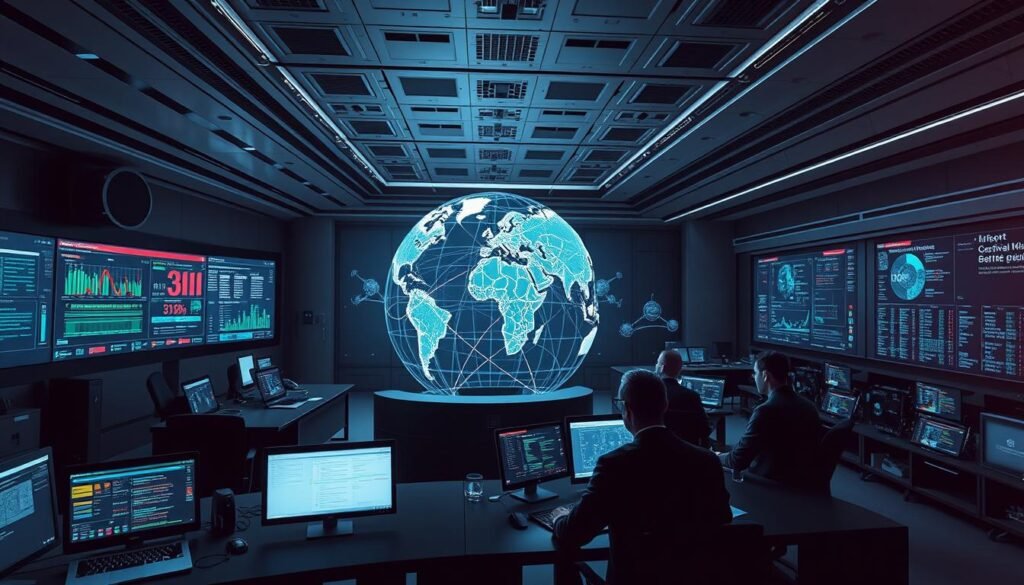
U.S. critical infrastructure demands a multi-layered defense system. This system must operate in real-time. It relies on well-structured information security protocols and clear internet security strategies. When combined with disciplined network security measures and practical cybersecurity solutions, it offers fast visibility and tighter control over IT and OT.
Detecting LOTL in IT/OT: baselining, SIEM correlation, and IDS tuning
Living-off-the-land activity blends into normal traffic patterns. Begin by establishing baseline performance for Windows hosts, controllers, and field devices. Then, feed logs, flow data, and OT telemetry into a SIEM for correlation. This helps identify rare parent-child process chains and sudden protocol shifts.
Adjust IDS and anomaly models to recognize ICS patterns, such as Modbus, DNP3, and OPC UA. Monitor audit trails for signs of unsigned scripts, scheduled task abuse, and unexpected PowerShell usage. These steps transform weak signals into clear alerts.
Privileged access controls, AD protection, and network segmentation
Implement least privilege with strong MFA and time-bound elevation. Harden Active Directory by isolating domain controllers and monitoring attempts to access NTDS.dit. Use Protected Users and tiered admin models to reduce the impact of stolen valid accounts.
Segment IT from OT with tightly filtered gateways and one-way data diodes where possible. Block RDP exposure, restrict lateral tools, and separate management planes. These strategies align with attacker paths, placing practical roadblocks in their way.
Zero-day mitigation, patch orchestration, and secure-by-design principles
Speed up patch pipelines for edge devices from Fortinet, Ivanti Connect Secure, NETGEAR, Citrix, and Cisco. Utilize canary appliances and staged rollouts to minimize downtime while closing exploitable gaps. Review SSL-VPN crash logs tied to CVEs like CVE-2022-42475 to spot prior compromise.
Adopt secure-by-design defaults: minimal services, signed binaries, memory safety, and rich telemetry. These solutions shrink the attack surface and enhance post-incident recon.
Cross-sector CISA/NIST CPGs as minimum viable protections
Align controls to CISA and NIST Cybersecurity Performance Goals to address high-impact TTPs like VPN abuse, credential theft, and supply-chain risk. Map detections, response playbooks, and tabletop drills to these benchmarks.
Use a simple scorecard to track posture and drive funding decisions. Balanced internet security strategies, backed by information security protocols and measurable network security measures, foster resilient cybersecurity solutions.
Case Study Methodology: Applying Lessons from APT Campaigns to Improve Data Protection and Digital Privacy
Case studies transform threat intelligence into actionable strategies. They map adversary tactics to playbooks, focus on key metrics, and ensure legal compliance. The goal is to enhance data protection, digital privacy, and cybersecurity solutions based on real-world incidents.
Using sector-specific playbooks for telecom, energy, transportation, and water
Develop playbooks that outline tactics and tools from recent attacks. In telecom, consider PRC’s strategies and Operation Tainted Love and Soft Cell’s methods. These include identity theft and stealthy data collection.
In energy, improve ICS visibility and OT controls. Isolate plants from corporate IT. For transportation, monitor VPNs for unusual activity and firmware integrity. Water utilities should enforce strict IT/OT controls and alert on protocol misuse.
Each playbook should align with NIST SP 800-53 to strengthen data protection while respecting privacy.
Threat hunting for valid-account abuse and lateral movement to domain controllers
Focus on hunting valid-account misuse, sudden MFA fatigue, and unusual OAuth grants. Look for VPN session anomalies, time-zone changes, and device posture shifts. Track RDP lateral movement, encoded PowerShell, and suspicious use of PsExec or WMI.
Set high-signal alerts for attempts to access domain controllers, dump LSASS, or copy NTDS.dit. These efforts enhance internet security without disrupting operations.
Third-party and supply chain risk governance
Examine managed service providers and cloud identity brokers, drawing lessons from the JumpCloud incident. Validate code-signing integrity to counter stolen certificates. Review software update channels to prevent SolarWinds-style breaches.
Implement contract clauses for telemetry sharing, incident timelines, and evidence retention. This ensures data protection and privacy while enabling quick cybersecurity solution deployment.
Metrics for resilience: dwell time, mean time to detect, and mean time to respond
Measure success by reducing dwell time, lowering mean time to detect, and speeding up mean time to respond. Track containment rates for living-off-the-land activity and privilege escalation blocks. Evaluate playbook activation speed and false-positive ratios to refine strategies.
Ensure attribution readiness by preserving forensic artifacts, documenting circumstantial chains, and aligning reports with joint advisories from CISA, NSA, and the FBI. This supports cross-border sharing.
Conclusion
State-sponsored campaigns now pose a significant risk to U.S. critical infrastructure and democratic institutions. The targeting of critical infrastructure has doubled to 40%, with the average cost per incident reaching $1.6 million. The PRC’s Volt Typhoon uses living-off-the-land and Active Directory compromise. Russia focuses on supply-chain intrusions and election interference. North Korea finances operations through cryptocurrency heists, and Iran combines espionage with destructive attacks.
These cyber threats highlight the importance of Cybersecurity as the New Frontline for modern defense. Collective action is showing its worth. Joint advisories and guidance from various agencies are improving detection standards and setting baselines. Defense-in-depth practices, such as baselining and network segmentation, are becoming essential.
Yet, technology alone is insufficient. A legal attribution architecture is needed to connect technical and circumstantial indicators to enforceable state responsibility. When combined with operational collaboration and faster threat sharing, this framework enhances deterrence and protects civilian infrastructure. Treating Cybersecurity as the New Frontline requires a unified strategy to counter today’s cyber threats.
The future demands practical and urgent steps. Institutionalize joint operations, accelerate intelligence exchange, and harden identity and network paths. Prepare evidence for lawful recourse. By integrating policy, law, and engineering, the United States can deter hostile actors, improve sector resilience, and ensure online security keeps up with evolving trends.
FAQ
Why is cybersecurity described as the new frontline for national security?
FAQ
Why is cybersecurity described as the new frontline for national security?
Cybersecurity is now a frontline because state-backed actors target critical systems. These include communications, energy, transportation, and water. Recent analyses show nation-state focus on critical infrastructure doubled from 20% to 40% in two years. The average organizational cost per incident is about
FAQ
Why is cybersecurity described as the new frontline for national security?
Cybersecurity is now a frontline because state-backed actors target critical systems. These include communications, energy, transportation, and water. Recent analyses show nation-state focus on critical infrastructure doubled from 20% to 40% in two years. The average organizational cost per incident is about $1.6 million. Geopolitical conflicts, including the Russo-Ukrainian war, have normalized destructive malware and blended cyber operations with real-world effects.
Which nation-states pose the most persistent advanced persistent threat (APT) risks?
Four principal adversaries drive the highest risk: China, Russia, North Korea, and Iran. Their APT ecosystems leverage state resources, deep operational security, and specialized talent. They blend espionage, disruption, and monetization, often striking defense, energy, telecom, higher education, and government networks while erasing boundaries between spying and cybercrime.
What is Volt Typhoon and why are U.S. and allied agencies warning about it?
Volt Typhoon is a PRC-linked campaign pre-positioning inside U.S. critical sectors. Joint advisories from CISA, NSA, FBI, DOE, EPA, TSA, ASD/ACSC, CCCS/CSE, NCSC-UK, and NCSC-NZ report living-off-the-land techniques, valid credential use, and long-term persistence—sometimes up to five years. The operation targets communications, energy, transportation, and water, often through VPN appliances and Active Directory compromise.
How do living-off-the-land (LOTL) techniques evade traditional defenses?
LOTL relies on native binaries, command-line tools, and commercial utilities, not custom malware. This blends attacker actions with normal admin activity and reduces forensic footprints. Detecting LOTL requires baselining behavior, SIEM correlation, IDS tuning for ICS traffic, and tight privileged access controls across IT and OT environments.
What did recent reporting reveal about costs and impacts of nation-state cyber incidents?
Organizations estimate average costs of $1.6 million per incident, covering business disruption, response, legal work, and remediation. Sectoral impacts include service outages in healthcare, theft of intellectual property, and risks to industrial control systems. Election interference and probing of underwater cables and grids raise the threat of physical-world harm.
How have Russian APT operations evolved from Moonlight Maze to SolarWinds?
Russian groups such as APT28, APT29, Turla, Sandworm, and Gamaredon progressed from classic espionage to supply-chain compromises and disruptive attacks. Highlights include election interference, the SolarWinds intrusion, ICS-focused capabilities, the Snake implant for long-term collection, and wipers like HermeticWiper used in Ukraine.
What distinguishes North Korea’s Lazarus and BlueNoroff clusters?
They pair espionage with aggressive revenue generation. Beyond the Sony attack and WannaCry, they orchestrate cryptocurrency heists, target banks and SWIFT, and exploit supply chains and zero-days. Activity from ScarCruft, Kimsuky, and incidents like the JumpCloud intrusion show focus on cloud and MSP pathways to scale access.
How do Iranian groups like APT33, APT34, MuddyWater, and APT35 operate?
Their playbook mixes espionage, destructive actions, and influence. Tactics include domain spoofing, social engineering, DNS tunneling, and cloud-based command and control. They rapidly weaponize new vulnerabilities such as Log4j and ProxyShell, and have a history of wiper operations like Shamoon against energy targets.
Which historical incidents shaped today’s cyber risk landscape?
Early signals include the Farewell Dossier and the Chaos Computer Club. Modern milestones include Titan Rain and APT1, the Estonia DDoS, Stuxnet’s attack on nuclear infrastructure, the Sony breach, and Mirai’s hit on internet infrastructure. These events show the shift from isolated hacks to systemic, global risks.
What are effective network security measures against APT tactics?
Priorities include segmentation between IT and OT, privileged access management, Active Directory hardening, and continuous monitoring. Detect valid-account misuse, RDP lateral movement, and attempts to access or exfiltrate NTDS.dit. Speed patching across Fortinet, Ivanti Connect Secure, NETGEAR, Citrix, and Cisco, and adopt secure-by-design architecture to strengthen online security.
How should organizations detect and respond to LOTL activity in critical infrastructure?
Establish operational baselines, correlate events in SIEM, and tune IDS for ICS anomalies. Monitor admin actions, VPN session patterns, and PowerShell or WMI usage. Review SSL-VPN crash logs for exploitation signatures like CVE-2022-42475 on FortiGate. Align detections with CISA/NIST Cybersecurity Performance Goals to improve internet security strategies.
What role do global digital defense pacts and joint advisories play?
They accelerate threat intelligence sharing and harmonize mitigations across allies. Joint guidance from CISA, NSA, FBI, and Five Eyes partners enhances detection of LOTL, promotes secure-by-design, and sets expectations for protecting civilian infrastructure. This cooperation strengthens deterrence and improves incident response across borders.
How can legal frameworks improve attribution and deterrence of state-backed cyberattacks?
Legal scholarship argues that technical and circumstantial evidence can meet standards of proof for state responsibility. Blending adversarial or inquisitorial procedures with tailored evidentiary rules enables accountability while protecting sensitive sources. Doctrines can attribute proxy actions to states, and hybrid tribunals could deliver faster remedies for cyber disputes.
What case studies illustrate China’s broader APT tradecraft beyond Volt Typhoon?
APT10 targeted healthcare and aerospace; APT17 has ties to Operation Aurora and CCleaner; APT41 blends espionage and financial crime; Aoqin Dragon uses document exploits and DNS tunneling; WIP19 leveraged stolen certificates; and Operation Tainted Love struck telecom providers. These show supply-chain access and LOTL as enduring techniques.
How should sectors build playbooks to enhance data protection and digital privacy?
Create sector-specific runbooks: telecom focuses on PRC targeting and signaling anomalies; energy emphasizes ICS visibility and OT pivot defenses; transportation prioritizes VPN appliance monitoring; water utilities lock down IT/OT paths. Track dwell time, mean time to detect, and mean time to respond to measure resilience and validate information security protocols.
Which cybersecurity solutions and controls deliver the most impact quickly?
Start with multi-factor authentication, PAM, EDR with behavioral analytics, and robust logging. Enforce network segmentation, zero-trust access, rapid patch orchestration, and backup integrity testing. Deploy ICS-aware IDS, DNS monitoring, and script-blocking policies. These defenses reduce lateral movement and boost data protection and digital privacy.
How does supply-chain risk factor into nation-state campaigns?
Adversaries exploit MSPs, cloud providers, software update channels, and stolen code-signing certificates to scale access, as seen in SolarWinds, WIP19, and the JumpCloud incident. Strong vendor due diligence, SBOM usage, code-signing integrity checks, and continuous third-party monitoring are essential cybersecurity trends for systemic risk control.
What minimum safeguards should organizations adopt now?
Implement the CISA/NIST Cybersecurity Performance Goals as cross-sector baselines. Focus on credential hygiene, identity-centric controls, network segmentation, SIEM integration, and rapid patching for perimeter devices. These internet security strategies harden environments against VPN abuse, credential theft, and supply-chain compromise.
How can organizations prepare evidence for credible attribution and policy action?
Preserve forensic artifacts, maintain chain-of-custody, and document circumstantial links across incidents. Standardize reports to match joint advisory formats to ease cross-border sharing. This approach supports a procedural legal framework that strengthens accountability and improves deterrence against state-backed cyber threats.
.6 million. Geopolitical conflicts, including the Russo-Ukrainian war, have normalized destructive malware and blended cyber operations with real-world effects.
Which nation-states pose the most persistent advanced persistent threat (APT) risks?
Four principal adversaries drive the highest risk: China, Russia, North Korea, and Iran. Their APT ecosystems leverage state resources, deep operational security, and specialized talent. They blend espionage, disruption, and monetization, often striking defense, energy, telecom, higher education, and government networks while erasing boundaries between spying and cybercrime.
What is Volt Typhoon and why are U.S. and allied agencies warning about it?
Volt Typhoon is a PRC-linked campaign pre-positioning inside U.S. critical sectors. Joint advisories from CISA, NSA, FBI, DOE, EPA, TSA, ASD/ACSC, CCCS/CSE, NCSC-UK, and NCSC-NZ report living-off-the-land techniques, valid credential use, and long-term persistence—sometimes up to five years. The operation targets communications, energy, transportation, and water, often through VPN appliances and Active Directory compromise.
How do living-off-the-land (LOTL) techniques evade traditional defenses?
LOTL relies on native binaries, command-line tools, and commercial utilities, not custom malware. This blends attacker actions with normal admin activity and reduces forensic footprints. Detecting LOTL requires baselining behavior, SIEM correlation, IDS tuning for ICS traffic, and tight privileged access controls across IT and OT environments.
What did recent reporting reveal about costs and impacts of nation-state cyber incidents?
Organizations estimate average costs of
FAQ
Why is cybersecurity described as the new frontline for national security?
Cybersecurity is now a frontline because state-backed actors target critical systems. These include communications, energy, transportation, and water. Recent analyses show nation-state focus on critical infrastructure doubled from 20% to 40% in two years. The average organizational cost per incident is about $1.6 million. Geopolitical conflicts, including the Russo-Ukrainian war, have normalized destructive malware and blended cyber operations with real-world effects.
Which nation-states pose the most persistent advanced persistent threat (APT) risks?
Four principal adversaries drive the highest risk: China, Russia, North Korea, and Iran. Their APT ecosystems leverage state resources, deep operational security, and specialized talent. They blend espionage, disruption, and monetization, often striking defense, energy, telecom, higher education, and government networks while erasing boundaries between spying and cybercrime.
What is Volt Typhoon and why are U.S. and allied agencies warning about it?
Volt Typhoon is a PRC-linked campaign pre-positioning inside U.S. critical sectors. Joint advisories from CISA, NSA, FBI, DOE, EPA, TSA, ASD/ACSC, CCCS/CSE, NCSC-UK, and NCSC-NZ report living-off-the-land techniques, valid credential use, and long-term persistence—sometimes up to five years. The operation targets communications, energy, transportation, and water, often through VPN appliances and Active Directory compromise.
How do living-off-the-land (LOTL) techniques evade traditional defenses?
LOTL relies on native binaries, command-line tools, and commercial utilities, not custom malware. This blends attacker actions with normal admin activity and reduces forensic footprints. Detecting LOTL requires baselining behavior, SIEM correlation, IDS tuning for ICS traffic, and tight privileged access controls across IT and OT environments.
What did recent reporting reveal about costs and impacts of nation-state cyber incidents?
Organizations estimate average costs of $1.6 million per incident, covering business disruption, response, legal work, and remediation. Sectoral impacts include service outages in healthcare, theft of intellectual property, and risks to industrial control systems. Election interference and probing of underwater cables and grids raise the threat of physical-world harm.
How have Russian APT operations evolved from Moonlight Maze to SolarWinds?
Russian groups such as APT28, APT29, Turla, Sandworm, and Gamaredon progressed from classic espionage to supply-chain compromises and disruptive attacks. Highlights include election interference, the SolarWinds intrusion, ICS-focused capabilities, the Snake implant for long-term collection, and wipers like HermeticWiper used in Ukraine.
What distinguishes North Korea’s Lazarus and BlueNoroff clusters?
They pair espionage with aggressive revenue generation. Beyond the Sony attack and WannaCry, they orchestrate cryptocurrency heists, target banks and SWIFT, and exploit supply chains and zero-days. Activity from ScarCruft, Kimsuky, and incidents like the JumpCloud intrusion show focus on cloud and MSP pathways to scale access.
How do Iranian groups like APT33, APT34, MuddyWater, and APT35 operate?
Their playbook mixes espionage, destructive actions, and influence. Tactics include domain spoofing, social engineering, DNS tunneling, and cloud-based command and control. They rapidly weaponize new vulnerabilities such as Log4j and ProxyShell, and have a history of wiper operations like Shamoon against energy targets.
Which historical incidents shaped today’s cyber risk landscape?
Early signals include the Farewell Dossier and the Chaos Computer Club. Modern milestones include Titan Rain and APT1, the Estonia DDoS, Stuxnet’s attack on nuclear infrastructure, the Sony breach, and Mirai’s hit on internet infrastructure. These events show the shift from isolated hacks to systemic, global risks.
What are effective network security measures against APT tactics?
Priorities include segmentation between IT and OT, privileged access management, Active Directory hardening, and continuous monitoring. Detect valid-account misuse, RDP lateral movement, and attempts to access or exfiltrate NTDS.dit. Speed patching across Fortinet, Ivanti Connect Secure, NETGEAR, Citrix, and Cisco, and adopt secure-by-design architecture to strengthen online security.
How should organizations detect and respond to LOTL activity in critical infrastructure?
Establish operational baselines, correlate events in SIEM, and tune IDS for ICS anomalies. Monitor admin actions, VPN session patterns, and PowerShell or WMI usage. Review SSL-VPN crash logs for exploitation signatures like CVE-2022-42475 on FortiGate. Align detections with CISA/NIST Cybersecurity Performance Goals to improve internet security strategies.
What role do global digital defense pacts and joint advisories play?
They accelerate threat intelligence sharing and harmonize mitigations across allies. Joint guidance from CISA, NSA, FBI, and Five Eyes partners enhances detection of LOTL, promotes secure-by-design, and sets expectations for protecting civilian infrastructure. This cooperation strengthens deterrence and improves incident response across borders.
How can legal frameworks improve attribution and deterrence of state-backed cyberattacks?
Legal scholarship argues that technical and circumstantial evidence can meet standards of proof for state responsibility. Blending adversarial or inquisitorial procedures with tailored evidentiary rules enables accountability while protecting sensitive sources. Doctrines can attribute proxy actions to states, and hybrid tribunals could deliver faster remedies for cyber disputes.
What case studies illustrate China’s broader APT tradecraft beyond Volt Typhoon?
APT10 targeted healthcare and aerospace; APT17 has ties to Operation Aurora and CCleaner; APT41 blends espionage and financial crime; Aoqin Dragon uses document exploits and DNS tunneling; WIP19 leveraged stolen certificates; and Operation Tainted Love struck telecom providers. These show supply-chain access and LOTL as enduring techniques.
How should sectors build playbooks to enhance data protection and digital privacy?
Create sector-specific runbooks: telecom focuses on PRC targeting and signaling anomalies; energy emphasizes ICS visibility and OT pivot defenses; transportation prioritizes VPN appliance monitoring; water utilities lock down IT/OT paths. Track dwell time, mean time to detect, and mean time to respond to measure resilience and validate information security protocols.
Which cybersecurity solutions and controls deliver the most impact quickly?
Start with multi-factor authentication, PAM, EDR with behavioral analytics, and robust logging. Enforce network segmentation, zero-trust access, rapid patch orchestration, and backup integrity testing. Deploy ICS-aware IDS, DNS monitoring, and script-blocking policies. These defenses reduce lateral movement and boost data protection and digital privacy.
How does supply-chain risk factor into nation-state campaigns?
Adversaries exploit MSPs, cloud providers, software update channels, and stolen code-signing certificates to scale access, as seen in SolarWinds, WIP19, and the JumpCloud incident. Strong vendor due diligence, SBOM usage, code-signing integrity checks, and continuous third-party monitoring are essential cybersecurity trends for systemic risk control.
What minimum safeguards should organizations adopt now?
Implement the CISA/NIST Cybersecurity Performance Goals as cross-sector baselines. Focus on credential hygiene, identity-centric controls, network segmentation, SIEM integration, and rapid patching for perimeter devices. These internet security strategies harden environments against VPN abuse, credential theft, and supply-chain compromise.
How can organizations prepare evidence for credible attribution and policy action?
Preserve forensic artifacts, maintain chain-of-custody, and document circumstantial links across incidents. Standardize reports to match joint advisory formats to ease cross-border sharing. This approach supports a procedural legal framework that strengthens accountability and improves deterrence against state-backed cyber threats.
.6 million per incident, covering business disruption, response, legal work, and remediation. Sectoral impacts include service outages in healthcare, theft of intellectual property, and risks to industrial control systems. Election interference and probing of underwater cables and grids raise the threat of physical-world harm.
How have Russian APT operations evolved from Moonlight Maze to SolarWinds?
Russian groups such as APT28, APT29, Turla, Sandworm, and Gamaredon progressed from classic espionage to supply-chain compromises and disruptive attacks. Highlights include election interference, the SolarWinds intrusion, ICS-focused capabilities, the Snake implant for long-term collection, and wipers like HermeticWiper used in Ukraine.
What distinguishes North Korea’s Lazarus and BlueNoroff clusters?
They pair espionage with aggressive revenue generation. Beyond the Sony attack and WannaCry, they orchestrate cryptocurrency heists, target banks and SWIFT, and exploit supply chains and zero-days. Activity from ScarCruft, Kimsuky, and incidents like the JumpCloud intrusion show focus on cloud and MSP pathways to scale access.
How do Iranian groups like APT33, APT34, MuddyWater, and APT35 operate?
Their playbook mixes espionage, destructive actions, and influence. Tactics include domain spoofing, social engineering, DNS tunneling, and cloud-based command and control. They rapidly weaponize new vulnerabilities such as Log4j and ProxyShell, and have a history of wiper operations like Shamoon against energy targets.
Which historical incidents shaped today’s cyber risk landscape?
Early signals include the Farewell Dossier and the Chaos Computer Club. Modern milestones include Titan Rain and APT1, the Estonia DDoS, Stuxnet’s attack on nuclear infrastructure, the Sony breach, and Mirai’s hit on internet infrastructure. These events show the shift from isolated hacks to systemic, global risks.
What are effective network security measures against APT tactics?
Priorities include segmentation between IT and OT, privileged access management, Active Directory hardening, and continuous monitoring. Detect valid-account misuse, RDP lateral movement, and attempts to access or exfiltrate NTDS.dit. Speed patching across Fortinet, Ivanti Connect Secure, NETGEAR, Citrix, and Cisco, and adopt secure-by-design architecture to strengthen online security.
How should organizations detect and respond to LOTL activity in critical infrastructure?
Establish operational baselines, correlate events in SIEM, and tune IDS for ICS anomalies. Monitor admin actions, VPN session patterns, and PowerShell or WMI usage. Review SSL-VPN crash logs for exploitation signatures like CVE-2022-42475 on FortiGate. Align detections with CISA/NIST Cybersecurity Performance Goals to improve internet security strategies.
What role do global digital defense pacts and joint advisories play?
They accelerate threat intelligence sharing and harmonize mitigations across allies. Joint guidance from CISA, NSA, FBI, and Five Eyes partners enhances detection of LOTL, promotes secure-by-design, and sets expectations for protecting civilian infrastructure. This cooperation strengthens deterrence and improves incident response across borders.
How can legal frameworks improve attribution and deterrence of state-backed cyberattacks?
Legal scholarship argues that technical and circumstantial evidence can meet standards of proof for state responsibility. Blending adversarial or inquisitorial procedures with tailored evidentiary rules enables accountability while protecting sensitive sources. Doctrines can attribute proxy actions to states, and hybrid tribunals could deliver faster remedies for cyber disputes.
What case studies illustrate China’s broader APT tradecraft beyond Volt Typhoon?
APT10 targeted healthcare and aerospace; APT17 has ties to Operation Aurora and CCleaner; APT41 blends espionage and financial crime; Aoqin Dragon uses document exploits and DNS tunneling; WIP19 leveraged stolen certificates; and Operation Tainted Love struck telecom providers. These show supply-chain access and LOTL as enduring techniques.
How should sectors build playbooks to enhance data protection and digital privacy?
Create sector-specific runbooks: telecom focuses on PRC targeting and signaling anomalies; energy emphasizes ICS visibility and OT pivot defenses; transportation prioritizes VPN appliance monitoring; water utilities lock down IT/OT paths. Track dwell time, mean time to detect, and mean time to respond to measure resilience and validate information security protocols.
Which cybersecurity solutions and controls deliver the most impact quickly?
Start with multi-factor authentication, PAM, EDR with behavioral analytics, and robust logging. Enforce network segmentation, zero-trust access, rapid patch orchestration, and backup integrity testing. Deploy ICS-aware IDS, DNS monitoring, and script-blocking policies. These defenses reduce lateral movement and boost data protection and digital privacy.
How does supply-chain risk factor into nation-state campaigns?
Adversaries exploit MSPs, cloud providers, software update channels, and stolen code-signing certificates to scale access, as seen in SolarWinds, WIP19, and the JumpCloud incident. Strong vendor due diligence, SBOM usage, code-signing integrity checks, and continuous third-party monitoring are essential cybersecurity trends for systemic risk control.
What minimum safeguards should organizations adopt now?
Implement the CISA/NIST Cybersecurity Performance Goals as cross-sector baselines. Focus on credential hygiene, identity-centric controls, network segmentation, SIEM integration, and rapid patching for perimeter devices. These internet security strategies harden environments against VPN abuse, credential theft, and supply-chain compromise.
How can organizations prepare evidence for credible attribution and policy action?
Preserve forensic artifacts, maintain chain-of-custody, and document circumstantial links across incidents. Standardize reports to match joint advisory formats to ease cross-border sharing. This approach supports a procedural legal framework that strengthens accountability and improves deterrence against state-backed cyber threats.
FAQ
Why is cybersecurity described as the new frontline for national security?
Cybersecurity is now a frontline because state-backed actors target critical systems. These include communications, energy, transportation, and water. Recent analyses show nation-state focus on critical infrastructure doubled from 20% to 40% in two years. The average organizational cost per incident is about
FAQ
Why is cybersecurity described as the new frontline for national security?
Cybersecurity is now a frontline because state-backed actors target critical systems. These include communications, energy, transportation, and water. Recent analyses show nation-state focus on critical infrastructure doubled from 20% to 40% in two years. The average organizational cost per incident is about $1.6 million. Geopolitical conflicts, including the Russo-Ukrainian war, have normalized destructive malware and blended cyber operations with real-world effects.
Which nation-states pose the most persistent advanced persistent threat (APT) risks?
Four principal adversaries drive the highest risk: China, Russia, North Korea, and Iran. Their APT ecosystems leverage state resources, deep operational security, and specialized talent. They blend espionage, disruption, and monetization, often striking defense, energy, telecom, higher education, and government networks while erasing boundaries between spying and cybercrime.
What is Volt Typhoon and why are U.S. and allied agencies warning about it?
Volt Typhoon is a PRC-linked campaign pre-positioning inside U.S. critical sectors. Joint advisories from CISA, NSA, FBI, DOE, EPA, TSA, ASD/ACSC, CCCS/CSE, NCSC-UK, and NCSC-NZ report living-off-the-land techniques, valid credential use, and long-term persistence—sometimes up to five years. The operation targets communications, energy, transportation, and water, often through VPN appliances and Active Directory compromise.
How do living-off-the-land (LOTL) techniques evade traditional defenses?
LOTL relies on native binaries, command-line tools, and commercial utilities, not custom malware. This blends attacker actions with normal admin activity and reduces forensic footprints. Detecting LOTL requires baselining behavior, SIEM correlation, IDS tuning for ICS traffic, and tight privileged access controls across IT and OT environments.
What did recent reporting reveal about costs and impacts of nation-state cyber incidents?
Organizations estimate average costs of $1.6 million per incident, covering business disruption, response, legal work, and remediation. Sectoral impacts include service outages in healthcare, theft of intellectual property, and risks to industrial control systems. Election interference and probing of underwater cables and grids raise the threat of physical-world harm.
How have Russian APT operations evolved from Moonlight Maze to SolarWinds?
Russian groups such as APT28, APT29, Turla, Sandworm, and Gamaredon progressed from classic espionage to supply-chain compromises and disruptive attacks. Highlights include election interference, the SolarWinds intrusion, ICS-focused capabilities, the Snake implant for long-term collection, and wipers like HermeticWiper used in Ukraine.
What distinguishes North Korea’s Lazarus and BlueNoroff clusters?
They pair espionage with aggressive revenue generation. Beyond the Sony attack and WannaCry, they orchestrate cryptocurrency heists, target banks and SWIFT, and exploit supply chains and zero-days. Activity from ScarCruft, Kimsuky, and incidents like the JumpCloud intrusion show focus on cloud and MSP pathways to scale access.
How do Iranian groups like APT33, APT34, MuddyWater, and APT35 operate?
Their playbook mixes espionage, destructive actions, and influence. Tactics include domain spoofing, social engineering, DNS tunneling, and cloud-based command and control. They rapidly weaponize new vulnerabilities such as Log4j and ProxyShell, and have a history of wiper operations like Shamoon against energy targets.
Which historical incidents shaped today’s cyber risk landscape?
Early signals include the Farewell Dossier and the Chaos Computer Club. Modern milestones include Titan Rain and APT1, the Estonia DDoS, Stuxnet’s attack on nuclear infrastructure, the Sony breach, and Mirai’s hit on internet infrastructure. These events show the shift from isolated hacks to systemic, global risks.
What are effective network security measures against APT tactics?
Priorities include segmentation between IT and OT, privileged access management, Active Directory hardening, and continuous monitoring. Detect valid-account misuse, RDP lateral movement, and attempts to access or exfiltrate NTDS.dit. Speed patching across Fortinet, Ivanti Connect Secure, NETGEAR, Citrix, and Cisco, and adopt secure-by-design architecture to strengthen online security.
How should organizations detect and respond to LOTL activity in critical infrastructure?
Establish operational baselines, correlate events in SIEM, and tune IDS for ICS anomalies. Monitor admin actions, VPN session patterns, and PowerShell or WMI usage. Review SSL-VPN crash logs for exploitation signatures like CVE-2022-42475 on FortiGate. Align detections with CISA/NIST Cybersecurity Performance Goals to improve internet security strategies.
What role do global digital defense pacts and joint advisories play?
They accelerate threat intelligence sharing and harmonize mitigations across allies. Joint guidance from CISA, NSA, FBI, and Five Eyes partners enhances detection of LOTL, promotes secure-by-design, and sets expectations for protecting civilian infrastructure. This cooperation strengthens deterrence and improves incident response across borders.
How can legal frameworks improve attribution and deterrence of state-backed cyberattacks?
Legal scholarship argues that technical and circumstantial evidence can meet standards of proof for state responsibility. Blending adversarial or inquisitorial procedures with tailored evidentiary rules enables accountability while protecting sensitive sources. Doctrines can attribute proxy actions to states, and hybrid tribunals could deliver faster remedies for cyber disputes.
What case studies illustrate China’s broader APT tradecraft beyond Volt Typhoon?
APT10 targeted healthcare and aerospace; APT17 has ties to Operation Aurora and CCleaner; APT41 blends espionage and financial crime; Aoqin Dragon uses document exploits and DNS tunneling; WIP19 leveraged stolen certificates; and Operation Tainted Love struck telecom providers. These show supply-chain access and LOTL as enduring techniques.
How should sectors build playbooks to enhance data protection and digital privacy?
Create sector-specific runbooks: telecom focuses on PRC targeting and signaling anomalies; energy emphasizes ICS visibility and OT pivot defenses; transportation prioritizes VPN appliance monitoring; water utilities lock down IT/OT paths. Track dwell time, mean time to detect, and mean time to respond to measure resilience and validate information security protocols.
Which cybersecurity solutions and controls deliver the most impact quickly?
Start with multi-factor authentication, PAM, EDR with behavioral analytics, and robust logging. Enforce network segmentation, zero-trust access, rapid patch orchestration, and backup integrity testing. Deploy ICS-aware IDS, DNS monitoring, and script-blocking policies. These defenses reduce lateral movement and boost data protection and digital privacy.
How does supply-chain risk factor into nation-state campaigns?
Adversaries exploit MSPs, cloud providers, software update channels, and stolen code-signing certificates to scale access, as seen in SolarWinds, WIP19, and the JumpCloud incident. Strong vendor due diligence, SBOM usage, code-signing integrity checks, and continuous third-party monitoring are essential cybersecurity trends for systemic risk control.
What minimum safeguards should organizations adopt now?
Implement the CISA/NIST Cybersecurity Performance Goals as cross-sector baselines. Focus on credential hygiene, identity-centric controls, network segmentation, SIEM integration, and rapid patching for perimeter devices. These internet security strategies harden environments against VPN abuse, credential theft, and supply-chain compromise.
How can organizations prepare evidence for credible attribution and policy action?
Preserve forensic artifacts, maintain chain-of-custody, and document circumstantial links across incidents. Standardize reports to match joint advisory formats to ease cross-border sharing. This approach supports a procedural legal framework that strengthens accountability and improves deterrence against state-backed cyber threats.
.6 million. Geopolitical conflicts, including the Russo-Ukrainian war, have normalized destructive malware and blended cyber operations with real-world effects.
Which nation-states pose the most persistent advanced persistent threat (APT) risks?
Four principal adversaries drive the highest risk: China, Russia, North Korea, and Iran. Their APT ecosystems leverage state resources, deep operational security, and specialized talent. They blend espionage, disruption, and monetization, often striking defense, energy, telecom, higher education, and government networks while erasing boundaries between spying and cybercrime.
What is Volt Typhoon and why are U.S. and allied agencies warning about it?
Volt Typhoon is a PRC-linked campaign pre-positioning inside U.S. critical sectors. Joint advisories from CISA, NSA, FBI, DOE, EPA, TSA, ASD/ACSC, CCCS/CSE, NCSC-UK, and NCSC-NZ report living-off-the-land techniques, valid credential use, and long-term persistence—sometimes up to five years. The operation targets communications, energy, transportation, and water, often through VPN appliances and Active Directory compromise.
How do living-off-the-land (LOTL) techniques evade traditional defenses?
LOTL relies on native binaries, command-line tools, and commercial utilities, not custom malware. This blends attacker actions with normal admin activity and reduces forensic footprints. Detecting LOTL requires baselining behavior, SIEM correlation, IDS tuning for ICS traffic, and tight privileged access controls across IT and OT environments.
What did recent reporting reveal about costs and impacts of nation-state cyber incidents?
Organizations estimate average costs of
FAQ
Why is cybersecurity described as the new frontline for national security?
Cybersecurity is now a frontline because state-backed actors target critical systems. These include communications, energy, transportation, and water. Recent analyses show nation-state focus on critical infrastructure doubled from 20% to 40% in two years. The average organizational cost per incident is about $1.6 million. Geopolitical conflicts, including the Russo-Ukrainian war, have normalized destructive malware and blended cyber operations with real-world effects.
Which nation-states pose the most persistent advanced persistent threat (APT) risks?
Four principal adversaries drive the highest risk: China, Russia, North Korea, and Iran. Their APT ecosystems leverage state resources, deep operational security, and specialized talent. They blend espionage, disruption, and monetization, often striking defense, energy, telecom, higher education, and government networks while erasing boundaries between spying and cybercrime.
What is Volt Typhoon and why are U.S. and allied agencies warning about it?
Volt Typhoon is a PRC-linked campaign pre-positioning inside U.S. critical sectors. Joint advisories from CISA, NSA, FBI, DOE, EPA, TSA, ASD/ACSC, CCCS/CSE, NCSC-UK, and NCSC-NZ report living-off-the-land techniques, valid credential use, and long-term persistence—sometimes up to five years. The operation targets communications, energy, transportation, and water, often through VPN appliances and Active Directory compromise.
How do living-off-the-land (LOTL) techniques evade traditional defenses?
LOTL relies on native binaries, command-line tools, and commercial utilities, not custom malware. This blends attacker actions with normal admin activity and reduces forensic footprints. Detecting LOTL requires baselining behavior, SIEM correlation, IDS tuning for ICS traffic, and tight privileged access controls across IT and OT environments.
What did recent reporting reveal about costs and impacts of nation-state cyber incidents?
Organizations estimate average costs of $1.6 million per incident, covering business disruption, response, legal work, and remediation. Sectoral impacts include service outages in healthcare, theft of intellectual property, and risks to industrial control systems. Election interference and probing of underwater cables and grids raise the threat of physical-world harm.
How have Russian APT operations evolved from Moonlight Maze to SolarWinds?
Russian groups such as APT28, APT29, Turla, Sandworm, and Gamaredon progressed from classic espionage to supply-chain compromises and disruptive attacks. Highlights include election interference, the SolarWinds intrusion, ICS-focused capabilities, the Snake implant for long-term collection, and wipers like HermeticWiper used in Ukraine.
What distinguishes North Korea’s Lazarus and BlueNoroff clusters?
They pair espionage with aggressive revenue generation. Beyond the Sony attack and WannaCry, they orchestrate cryptocurrency heists, target banks and SWIFT, and exploit supply chains and zero-days. Activity from ScarCruft, Kimsuky, and incidents like the JumpCloud intrusion show focus on cloud and MSP pathways to scale access.
How do Iranian groups like APT33, APT34, MuddyWater, and APT35 operate?
Their playbook mixes espionage, destructive actions, and influence. Tactics include domain spoofing, social engineering, DNS tunneling, and cloud-based command and control. They rapidly weaponize new vulnerabilities such as Log4j and ProxyShell, and have a history of wiper operations like Shamoon against energy targets.
Which historical incidents shaped today’s cyber risk landscape?
Early signals include the Farewell Dossier and the Chaos Computer Club. Modern milestones include Titan Rain and APT1, the Estonia DDoS, Stuxnet’s attack on nuclear infrastructure, the Sony breach, and Mirai’s hit on internet infrastructure. These events show the shift from isolated hacks to systemic, global risks.
What are effective network security measures against APT tactics?
Priorities include segmentation between IT and OT, privileged access management, Active Directory hardening, and continuous monitoring. Detect valid-account misuse, RDP lateral movement, and attempts to access or exfiltrate NTDS.dit. Speed patching across Fortinet, Ivanti Connect Secure, NETGEAR, Citrix, and Cisco, and adopt secure-by-design architecture to strengthen online security.
How should organizations detect and respond to LOTL activity in critical infrastructure?
Establish operational baselines, correlate events in SIEM, and tune IDS for ICS anomalies. Monitor admin actions, VPN session patterns, and PowerShell or WMI usage. Review SSL-VPN crash logs for exploitation signatures like CVE-2022-42475 on FortiGate. Align detections with CISA/NIST Cybersecurity Performance Goals to improve internet security strategies.
What role do global digital defense pacts and joint advisories play?
They accelerate threat intelligence sharing and harmonize mitigations across allies. Joint guidance from CISA, NSA, FBI, and Five Eyes partners enhances detection of LOTL, promotes secure-by-design, and sets expectations for protecting civilian infrastructure. This cooperation strengthens deterrence and improves incident response across borders.
How can legal frameworks improve attribution and deterrence of state-backed cyberattacks?
Legal scholarship argues that technical and circumstantial evidence can meet standards of proof for state responsibility. Blending adversarial or inquisitorial procedures with tailored evidentiary rules enables accountability while protecting sensitive sources. Doctrines can attribute proxy actions to states, and hybrid tribunals could deliver faster remedies for cyber disputes.
What case studies illustrate China’s broader APT tradecraft beyond Volt Typhoon?
APT10 targeted healthcare and aerospace; APT17 has ties to Operation Aurora and CCleaner; APT41 blends espionage and financial crime; Aoqin Dragon uses document exploits and DNS tunneling; WIP19 leveraged stolen certificates; and Operation Tainted Love struck telecom providers. These show supply-chain access and LOTL as enduring techniques.
How should sectors build playbooks to enhance data protection and digital privacy?
Create sector-specific runbooks: telecom focuses on PRC targeting and signaling anomalies; energy emphasizes ICS visibility and OT pivot defenses; transportation prioritizes VPN appliance monitoring; water utilities lock down IT/OT paths. Track dwell time, mean time to detect, and mean time to respond to measure resilience and validate information security protocols.
Which cybersecurity solutions and controls deliver the most impact quickly?
Start with multi-factor authentication, PAM, EDR with behavioral analytics, and robust logging. Enforce network segmentation, zero-trust access, rapid patch orchestration, and backup integrity testing. Deploy ICS-aware IDS, DNS monitoring, and script-blocking policies. These defenses reduce lateral movement and boost data protection and digital privacy.
How does supply-chain risk factor into nation-state campaigns?
Adversaries exploit MSPs, cloud providers, software update channels, and stolen code-signing certificates to scale access, as seen in SolarWinds, WIP19, and the JumpCloud incident. Strong vendor due diligence, SBOM usage, code-signing integrity checks, and continuous third-party monitoring are essential cybersecurity trends for systemic risk control.
What minimum safeguards should organizations adopt now?
Implement the CISA/NIST Cybersecurity Performance Goals as cross-sector baselines. Focus on credential hygiene, identity-centric controls, network segmentation, SIEM integration, and rapid patching for perimeter devices. These internet security strategies harden environments against VPN abuse, credential theft, and supply-chain compromise.
How can organizations prepare evidence for credible attribution and policy action?
Preserve forensic artifacts, maintain chain-of-custody, and document circumstantial links across incidents. Standardize reports to match joint advisory formats to ease cross-border sharing. This approach supports a procedural legal framework that strengthens accountability and improves deterrence against state-backed cyber threats.
.6 million per incident, covering business disruption, response, legal work, and remediation. Sectoral impacts include service outages in healthcare, theft of intellectual property, and risks to industrial control systems. Election interference and probing of underwater cables and grids raise the threat of physical-world harm.
How have Russian APT operations evolved from Moonlight Maze to SolarWinds?
Russian groups such as APT28, APT29, Turla, Sandworm, and Gamaredon progressed from classic espionage to supply-chain compromises and disruptive attacks. Highlights include election interference, the SolarWinds intrusion, ICS-focused capabilities, the Snake implant for long-term collection, and wipers like HermeticWiper used in Ukraine.
What distinguishes North Korea’s Lazarus and BlueNoroff clusters?
They pair espionage with aggressive revenue generation. Beyond the Sony attack and WannaCry, they orchestrate cryptocurrency heists, target banks and SWIFT, and exploit supply chains and zero-days. Activity from ScarCruft, Kimsuky, and incidents like the JumpCloud intrusion show focus on cloud and MSP pathways to scale access.
How do Iranian groups like APT33, APT34, MuddyWater, and APT35 operate?
Their playbook mixes espionage, destructive actions, and influence. Tactics include domain spoofing, social engineering, DNS tunneling, and cloud-based command and control. They rapidly weaponize new vulnerabilities such as Log4j and ProxyShell, and have a history of wiper operations like Shamoon against energy targets.
Which historical incidents shaped today’s cyber risk landscape?
Early signals include the Farewell Dossier and the Chaos Computer Club. Modern milestones include Titan Rain and APT1, the Estonia DDoS, Stuxnet’s attack on nuclear infrastructure, the Sony breach, and Mirai’s hit on internet infrastructure. These events show the shift from isolated hacks to systemic, global risks.
What are effective network security measures against APT tactics?
Priorities include segmentation between IT and OT, privileged access management, Active Directory hardening, and continuous monitoring. Detect valid-account misuse, RDP lateral movement, and attempts to access or exfiltrate NTDS.dit. Speed patching across Fortinet, Ivanti Connect Secure, NETGEAR, Citrix, and Cisco, and adopt secure-by-design architecture to strengthen online security.
How should organizations detect and respond to LOTL activity in critical infrastructure?
Establish operational baselines, correlate events in SIEM, and tune IDS for ICS anomalies. Monitor admin actions, VPN session patterns, and PowerShell or WMI usage. Review SSL-VPN crash logs for exploitation signatures like CVE-2022-42475 on FortiGate. Align detections with CISA/NIST Cybersecurity Performance Goals to improve internet security strategies.
What role do global digital defense pacts and joint advisories play?
They accelerate threat intelligence sharing and harmonize mitigations across allies. Joint guidance from CISA, NSA, FBI, and Five Eyes partners enhances detection of LOTL, promotes secure-by-design, and sets expectations for protecting civilian infrastructure. This cooperation strengthens deterrence and improves incident response across borders.
How can legal frameworks improve attribution and deterrence of state-backed cyberattacks?
Legal scholarship argues that technical and circumstantial evidence can meet standards of proof for state responsibility. Blending adversarial or inquisitorial procedures with tailored evidentiary rules enables accountability while protecting sensitive sources. Doctrines can attribute proxy actions to states, and hybrid tribunals could deliver faster remedies for cyber disputes.
What case studies illustrate China’s broader APT tradecraft beyond Volt Typhoon?
APT10 targeted healthcare and aerospace; APT17 has ties to Operation Aurora and CCleaner; APT41 blends espionage and financial crime; Aoqin Dragon uses document exploits and DNS tunneling; WIP19 leveraged stolen certificates; and Operation Tainted Love struck telecom providers. These show supply-chain access and LOTL as enduring techniques.
How should sectors build playbooks to enhance data protection and digital privacy?
Create sector-specific runbooks: telecom focuses on PRC targeting and signaling anomalies; energy emphasizes ICS visibility and OT pivot defenses; transportation prioritizes VPN appliance monitoring; water utilities lock down IT/OT paths. Track dwell time, mean time to detect, and mean time to respond to measure resilience and validate information security protocols.
Which cybersecurity solutions and controls deliver the most impact quickly?
Start with multi-factor authentication, PAM, EDR with behavioral analytics, and robust logging. Enforce network segmentation, zero-trust access, rapid patch orchestration, and backup integrity testing. Deploy ICS-aware IDS, DNS monitoring, and script-blocking policies. These defenses reduce lateral movement and boost data protection and digital privacy.
How does supply-chain risk factor into nation-state campaigns?
Adversaries exploit MSPs, cloud providers, software update channels, and stolen code-signing certificates to scale access, as seen in SolarWinds, WIP19, and the JumpCloud incident. Strong vendor due diligence, SBOM usage, code-signing integrity checks, and continuous third-party monitoring are essential cybersecurity trends for systemic risk control.
What minimum safeguards should organizations adopt now?
Implement the CISA/NIST Cybersecurity Performance Goals as cross-sector baselines. Focus on credential hygiene, identity-centric controls, network segmentation, SIEM integration, and rapid patching for perimeter devices. These internet security strategies harden environments against VPN abuse, credential theft, and supply-chain compromise.
How can organizations prepare evidence for credible attribution and policy action?
Preserve forensic artifacts, maintain chain-of-custody, and document circumstantial links across incidents. Standardize reports to match joint advisory formats to ease cross-border sharing. This approach supports a procedural legal framework that strengthens accountability and improves deterrence against state-backed cyber threats.
Which nation-states pose the most persistent advanced persistent threat (APT) risks?
What is Volt Typhoon and why are U.S. and allied agencies warning about it?
How do living-off-the-land (LOTL) techniques evade traditional defenses?
What did recent reporting reveal about costs and impacts of nation-state cyber incidents?
FAQ
Why is cybersecurity described as the new frontline for national security?
Cybersecurity is now a frontline because state-backed actors target critical systems. These include communications, energy, transportation, and water. Recent analyses show nation-state focus on critical infrastructure doubled from 20% to 40% in two years. The average organizational cost per incident is about
FAQ
Why is cybersecurity described as the new frontline for national security?
Cybersecurity is now a frontline because state-backed actors target critical systems. These include communications, energy, transportation, and water. Recent analyses show nation-state focus on critical infrastructure doubled from 20% to 40% in two years. The average organizational cost per incident is about $1.6 million. Geopolitical conflicts, including the Russo-Ukrainian war, have normalized destructive malware and blended cyber operations with real-world effects.
Which nation-states pose the most persistent advanced persistent threat (APT) risks?
Four principal adversaries drive the highest risk: China, Russia, North Korea, and Iran. Their APT ecosystems leverage state resources, deep operational security, and specialized talent. They blend espionage, disruption, and monetization, often striking defense, energy, telecom, higher education, and government networks while erasing boundaries between spying and cybercrime.
What is Volt Typhoon and why are U.S. and allied agencies warning about it?
Volt Typhoon is a PRC-linked campaign pre-positioning inside U.S. critical sectors. Joint advisories from CISA, NSA, FBI, DOE, EPA, TSA, ASD/ACSC, CCCS/CSE, NCSC-UK, and NCSC-NZ report living-off-the-land techniques, valid credential use, and long-term persistence—sometimes up to five years. The operation targets communications, energy, transportation, and water, often through VPN appliances and Active Directory compromise.
How do living-off-the-land (LOTL) techniques evade traditional defenses?
LOTL relies on native binaries, command-line tools, and commercial utilities, not custom malware. This blends attacker actions with normal admin activity and reduces forensic footprints. Detecting LOTL requires baselining behavior, SIEM correlation, IDS tuning for ICS traffic, and tight privileged access controls across IT and OT environments.
What did recent reporting reveal about costs and impacts of nation-state cyber incidents?
Organizations estimate average costs of $1.6 million per incident, covering business disruption, response, legal work, and remediation. Sectoral impacts include service outages in healthcare, theft of intellectual property, and risks to industrial control systems. Election interference and probing of underwater cables and grids raise the threat of physical-world harm.
How have Russian APT operations evolved from Moonlight Maze to SolarWinds?
Russian groups such as APT28, APT29, Turla, Sandworm, and Gamaredon progressed from classic espionage to supply-chain compromises and disruptive attacks. Highlights include election interference, the SolarWinds intrusion, ICS-focused capabilities, the Snake implant for long-term collection, and wipers like HermeticWiper used in Ukraine.
What distinguishes North Korea’s Lazarus and BlueNoroff clusters?
They pair espionage with aggressive revenue generation. Beyond the Sony attack and WannaCry, they orchestrate cryptocurrency heists, target banks and SWIFT, and exploit supply chains and zero-days. Activity from ScarCruft, Kimsuky, and incidents like the JumpCloud intrusion show focus on cloud and MSP pathways to scale access.
How do Iranian groups like APT33, APT34, MuddyWater, and APT35 operate?
Their playbook mixes espionage, destructive actions, and influence. Tactics include domain spoofing, social engineering, DNS tunneling, and cloud-based command and control. They rapidly weaponize new vulnerabilities such as Log4j and ProxyShell, and have a history of wiper operations like Shamoon against energy targets.
Which historical incidents shaped today’s cyber risk landscape?
Early signals include the Farewell Dossier and the Chaos Computer Club. Modern milestones include Titan Rain and APT1, the Estonia DDoS, Stuxnet’s attack on nuclear infrastructure, the Sony breach, and Mirai’s hit on internet infrastructure. These events show the shift from isolated hacks to systemic, global risks.
What are effective network security measures against APT tactics?
Priorities include segmentation between IT and OT, privileged access management, Active Directory hardening, and continuous monitoring. Detect valid-account misuse, RDP lateral movement, and attempts to access or exfiltrate NTDS.dit. Speed patching across Fortinet, Ivanti Connect Secure, NETGEAR, Citrix, and Cisco, and adopt secure-by-design architecture to strengthen online security.
How should organizations detect and respond to LOTL activity in critical infrastructure?
Establish operational baselines, correlate events in SIEM, and tune IDS for ICS anomalies. Monitor admin actions, VPN session patterns, and PowerShell or WMI usage. Review SSL-VPN crash logs for exploitation signatures like CVE-2022-42475 on FortiGate. Align detections with CISA/NIST Cybersecurity Performance Goals to improve internet security strategies.
What role do global digital defense pacts and joint advisories play?
They accelerate threat intelligence sharing and harmonize mitigations across allies. Joint guidance from CISA, NSA, FBI, and Five Eyes partners enhances detection of LOTL, promotes secure-by-design, and sets expectations for protecting civilian infrastructure. This cooperation strengthens deterrence and improves incident response across borders.
How can legal frameworks improve attribution and deterrence of state-backed cyberattacks?
Legal scholarship argues that technical and circumstantial evidence can meet standards of proof for state responsibility. Blending adversarial or inquisitorial procedures with tailored evidentiary rules enables accountability while protecting sensitive sources. Doctrines can attribute proxy actions to states, and hybrid tribunals could deliver faster remedies for cyber disputes.
What case studies illustrate China’s broader APT tradecraft beyond Volt Typhoon?
APT10 targeted healthcare and aerospace; APT17 has ties to Operation Aurora and CCleaner; APT41 blends espionage and financial crime; Aoqin Dragon uses document exploits and DNS tunneling; WIP19 leveraged stolen certificates; and Operation Tainted Love struck telecom providers. These show supply-chain access and LOTL as enduring techniques.
How should sectors build playbooks to enhance data protection and digital privacy?
Create sector-specific runbooks: telecom focuses on PRC targeting and signaling anomalies; energy emphasizes ICS visibility and OT pivot defenses; transportation prioritizes VPN appliance monitoring; water utilities lock down IT/OT paths. Track dwell time, mean time to detect, and mean time to respond to measure resilience and validate information security protocols.
Which cybersecurity solutions and controls deliver the most impact quickly?
Start with multi-factor authentication, PAM, EDR with behavioral analytics, and robust logging. Enforce network segmentation, zero-trust access, rapid patch orchestration, and backup integrity testing. Deploy ICS-aware IDS, DNS monitoring, and script-blocking policies. These defenses reduce lateral movement and boost data protection and digital privacy.
How does supply-chain risk factor into nation-state campaigns?
Adversaries exploit MSPs, cloud providers, software update channels, and stolen code-signing certificates to scale access, as seen in SolarWinds, WIP19, and the JumpCloud incident. Strong vendor due diligence, SBOM usage, code-signing integrity checks, and continuous third-party monitoring are essential cybersecurity trends for systemic risk control.
What minimum safeguards should organizations adopt now?
Implement the CISA/NIST Cybersecurity Performance Goals as cross-sector baselines. Focus on credential hygiene, identity-centric controls, network segmentation, SIEM integration, and rapid patching for perimeter devices. These internet security strategies harden environments against VPN abuse, credential theft, and supply-chain compromise.
How can organizations prepare evidence for credible attribution and policy action?
Preserve forensic artifacts, maintain chain-of-custody, and document circumstantial links across incidents. Standardize reports to match joint advisory formats to ease cross-border sharing. This approach supports a procedural legal framework that strengthens accountability and improves deterrence against state-backed cyber threats.
.6 million. Geopolitical conflicts, including the Russo-Ukrainian war, have normalized destructive malware and blended cyber operations with real-world effects.
Which nation-states pose the most persistent advanced persistent threat (APT) risks?
Four principal adversaries drive the highest risk: China, Russia, North Korea, and Iran. Their APT ecosystems leverage state resources, deep operational security, and specialized talent. They blend espionage, disruption, and monetization, often striking defense, energy, telecom, higher education, and government networks while erasing boundaries between spying and cybercrime.
What is Volt Typhoon and why are U.S. and allied agencies warning about it?
Volt Typhoon is a PRC-linked campaign pre-positioning inside U.S. critical sectors. Joint advisories from CISA, NSA, FBI, DOE, EPA, TSA, ASD/ACSC, CCCS/CSE, NCSC-UK, and NCSC-NZ report living-off-the-land techniques, valid credential use, and long-term persistence—sometimes up to five years. The operation targets communications, energy, transportation, and water, often through VPN appliances and Active Directory compromise.
How do living-off-the-land (LOTL) techniques evade traditional defenses?
LOTL relies on native binaries, command-line tools, and commercial utilities, not custom malware. This blends attacker actions with normal admin activity and reduces forensic footprints. Detecting LOTL requires baselining behavior, SIEM correlation, IDS tuning for ICS traffic, and tight privileged access controls across IT and OT environments.
What did recent reporting reveal about costs and impacts of nation-state cyber incidents?
Organizations estimate average costs of
FAQ
Why is cybersecurity described as the new frontline for national security?
Cybersecurity is now a frontline because state-backed actors target critical systems. These include communications, energy, transportation, and water. Recent analyses show nation-state focus on critical infrastructure doubled from 20% to 40% in two years. The average organizational cost per incident is about $1.6 million. Geopolitical conflicts, including the Russo-Ukrainian war, have normalized destructive malware and blended cyber operations with real-world effects.
Which nation-states pose the most persistent advanced persistent threat (APT) risks?
Four principal adversaries drive the highest risk: China, Russia, North Korea, and Iran. Their APT ecosystems leverage state resources, deep operational security, and specialized talent. They blend espionage, disruption, and monetization, often striking defense, energy, telecom, higher education, and government networks while erasing boundaries between spying and cybercrime.
What is Volt Typhoon and why are U.S. and allied agencies warning about it?
Volt Typhoon is a PRC-linked campaign pre-positioning inside U.S. critical sectors. Joint advisories from CISA, NSA, FBI, DOE, EPA, TSA, ASD/ACSC, CCCS/CSE, NCSC-UK, and NCSC-NZ report living-off-the-land techniques, valid credential use, and long-term persistence—sometimes up to five years. The operation targets communications, energy, transportation, and water, often through VPN appliances and Active Directory compromise.
How do living-off-the-land (LOTL) techniques evade traditional defenses?
LOTL relies on native binaries, command-line tools, and commercial utilities, not custom malware. This blends attacker actions with normal admin activity and reduces forensic footprints. Detecting LOTL requires baselining behavior, SIEM correlation, IDS tuning for ICS traffic, and tight privileged access controls across IT and OT environments.
What did recent reporting reveal about costs and impacts of nation-state cyber incidents?
Organizations estimate average costs of $1.6 million per incident, covering business disruption, response, legal work, and remediation. Sectoral impacts include service outages in healthcare, theft of intellectual property, and risks to industrial control systems. Election interference and probing of underwater cables and grids raise the threat of physical-world harm.
How have Russian APT operations evolved from Moonlight Maze to SolarWinds?
Russian groups such as APT28, APT29, Turla, Sandworm, and Gamaredon progressed from classic espionage to supply-chain compromises and disruptive attacks. Highlights include election interference, the SolarWinds intrusion, ICS-focused capabilities, the Snake implant for long-term collection, and wipers like HermeticWiper used in Ukraine.
What distinguishes North Korea’s Lazarus and BlueNoroff clusters?
They pair espionage with aggressive revenue generation. Beyond the Sony attack and WannaCry, they orchestrate cryptocurrency heists, target banks and SWIFT, and exploit supply chains and zero-days. Activity from ScarCruft, Kimsuky, and incidents like the JumpCloud intrusion show focus on cloud and MSP pathways to scale access.
How do Iranian groups like APT33, APT34, MuddyWater, and APT35 operate?
Their playbook mixes espionage, destructive actions, and influence. Tactics include domain spoofing, social engineering, DNS tunneling, and cloud-based command and control. They rapidly weaponize new vulnerabilities such as Log4j and ProxyShell, and have a history of wiper operations like Shamoon against energy targets.
Which historical incidents shaped today’s cyber risk landscape?
Early signals include the Farewell Dossier and the Chaos Computer Club. Modern milestones include Titan Rain and APT1, the Estonia DDoS, Stuxnet’s attack on nuclear infrastructure, the Sony breach, and Mirai’s hit on internet infrastructure. These events show the shift from isolated hacks to systemic, global risks.
What are effective network security measures against APT tactics?
Priorities include segmentation between IT and OT, privileged access management, Active Directory hardening, and continuous monitoring. Detect valid-account misuse, RDP lateral movement, and attempts to access or exfiltrate NTDS.dit. Speed patching across Fortinet, Ivanti Connect Secure, NETGEAR, Citrix, and Cisco, and adopt secure-by-design architecture to strengthen online security.
How should organizations detect and respond to LOTL activity in critical infrastructure?
Establish operational baselines, correlate events in SIEM, and tune IDS for ICS anomalies. Monitor admin actions, VPN session patterns, and PowerShell or WMI usage. Review SSL-VPN crash logs for exploitation signatures like CVE-2022-42475 on FortiGate. Align detections with CISA/NIST Cybersecurity Performance Goals to improve internet security strategies.
What role do global digital defense pacts and joint advisories play?
They accelerate threat intelligence sharing and harmonize mitigations across allies. Joint guidance from CISA, NSA, FBI, and Five Eyes partners enhances detection of LOTL, promotes secure-by-design, and sets expectations for protecting civilian infrastructure. This cooperation strengthens deterrence and improves incident response across borders.
How can legal frameworks improve attribution and deterrence of state-backed cyberattacks?
Legal scholarship argues that technical and circumstantial evidence can meet standards of proof for state responsibility. Blending adversarial or inquisitorial procedures with tailored evidentiary rules enables accountability while protecting sensitive sources. Doctrines can attribute proxy actions to states, and hybrid tribunals could deliver faster remedies for cyber disputes.
What case studies illustrate China’s broader APT tradecraft beyond Volt Typhoon?
APT10 targeted healthcare and aerospace; APT17 has ties to Operation Aurora and CCleaner; APT41 blends espionage and financial crime; Aoqin Dragon uses document exploits and DNS tunneling; WIP19 leveraged stolen certificates; and Operation Tainted Love struck telecom providers. These show supply-chain access and LOTL as enduring techniques.
How should sectors build playbooks to enhance data protection and digital privacy?
Create sector-specific runbooks: telecom focuses on PRC targeting and signaling anomalies; energy emphasizes ICS visibility and OT pivot defenses; transportation prioritizes VPN appliance monitoring; water utilities lock down IT/OT paths. Track dwell time, mean time to detect, and mean time to respond to measure resilience and validate information security protocols.
Which cybersecurity solutions and controls deliver the most impact quickly?
Start with multi-factor authentication, PAM, EDR with behavioral analytics, and robust logging. Enforce network segmentation, zero-trust access, rapid patch orchestration, and backup integrity testing. Deploy ICS-aware IDS, DNS monitoring, and script-blocking policies. These defenses reduce lateral movement and boost data protection and digital privacy.
How does supply-chain risk factor into nation-state campaigns?
Adversaries exploit MSPs, cloud providers, software update channels, and stolen code-signing certificates to scale access, as seen in SolarWinds, WIP19, and the JumpCloud incident. Strong vendor due diligence, SBOM usage, code-signing integrity checks, and continuous third-party monitoring are essential cybersecurity trends for systemic risk control.
What minimum safeguards should organizations adopt now?
Implement the CISA/NIST Cybersecurity Performance Goals as cross-sector baselines. Focus on credential hygiene, identity-centric controls, network segmentation, SIEM integration, and rapid patching for perimeter devices. These internet security strategies harden environments against VPN abuse, credential theft, and supply-chain compromise.
How can organizations prepare evidence for credible attribution and policy action?
Preserve forensic artifacts, maintain chain-of-custody, and document circumstantial links across incidents. Standardize reports to match joint advisory formats to ease cross-border sharing. This approach supports a procedural legal framework that strengthens accountability and improves deterrence against state-backed cyber threats.
.6 million per incident, covering business disruption, response, legal work, and remediation. Sectoral impacts include service outages in healthcare, theft of intellectual property, and risks to industrial control systems. Election interference and probing of underwater cables and grids raise the threat of physical-world harm.
How have Russian APT operations evolved from Moonlight Maze to SolarWinds?
Russian groups such as APT28, APT29, Turla, Sandworm, and Gamaredon progressed from classic espionage to supply-chain compromises and disruptive attacks. Highlights include election interference, the SolarWinds intrusion, ICS-focused capabilities, the Snake implant for long-term collection, and wipers like HermeticWiper used in Ukraine.
What distinguishes North Korea’s Lazarus and BlueNoroff clusters?
They pair espionage with aggressive revenue generation. Beyond the Sony attack and WannaCry, they orchestrate cryptocurrency heists, target banks and SWIFT, and exploit supply chains and zero-days. Activity from ScarCruft, Kimsuky, and incidents like the JumpCloud intrusion show focus on cloud and MSP pathways to scale access.
How do Iranian groups like APT33, APT34, MuddyWater, and APT35 operate?
Their playbook mixes espionage, destructive actions, and influence. Tactics include domain spoofing, social engineering, DNS tunneling, and cloud-based command and control. They rapidly weaponize new vulnerabilities such as Log4j and ProxyShell, and have a history of wiper operations like Shamoon against energy targets.
Which historical incidents shaped today’s cyber risk landscape?
Early signals include the Farewell Dossier and the Chaos Computer Club. Modern milestones include Titan Rain and APT1, the Estonia DDoS, Stuxnet’s attack on nuclear infrastructure, the Sony breach, and Mirai’s hit on internet infrastructure. These events show the shift from isolated hacks to systemic, global risks.
What are effective network security measures against APT tactics?
Priorities include segmentation between IT and OT, privileged access management, Active Directory hardening, and continuous monitoring. Detect valid-account misuse, RDP lateral movement, and attempts to access or exfiltrate NTDS.dit. Speed patching across Fortinet, Ivanti Connect Secure, NETGEAR, Citrix, and Cisco, and adopt secure-by-design architecture to strengthen online security.
How should organizations detect and respond to LOTL activity in critical infrastructure?
Establish operational baselines, correlate events in SIEM, and tune IDS for ICS anomalies. Monitor admin actions, VPN session patterns, and PowerShell or WMI usage. Review SSL-VPN crash logs for exploitation signatures like CVE-2022-42475 on FortiGate. Align detections with CISA/NIST Cybersecurity Performance Goals to improve internet security strategies.
What role do global digital defense pacts and joint advisories play?
They accelerate threat intelligence sharing and harmonize mitigations across allies. Joint guidance from CISA, NSA, FBI, and Five Eyes partners enhances detection of LOTL, promotes secure-by-design, and sets expectations for protecting civilian infrastructure. This cooperation strengthens deterrence and improves incident response across borders.
How can legal frameworks improve attribution and deterrence of state-backed cyberattacks?
Legal scholarship argues that technical and circumstantial evidence can meet standards of proof for state responsibility. Blending adversarial or inquisitorial procedures with tailored evidentiary rules enables accountability while protecting sensitive sources. Doctrines can attribute proxy actions to states, and hybrid tribunals could deliver faster remedies for cyber disputes.
What case studies illustrate China’s broader APT tradecraft beyond Volt Typhoon?
APT10 targeted healthcare and aerospace; APT17 has ties to Operation Aurora and CCleaner; APT41 blends espionage and financial crime; Aoqin Dragon uses document exploits and DNS tunneling; WIP19 leveraged stolen certificates; and Operation Tainted Love struck telecom providers. These show supply-chain access and LOTL as enduring techniques.
How should sectors build playbooks to enhance data protection and digital privacy?
Create sector-specific runbooks: telecom focuses on PRC targeting and signaling anomalies; energy emphasizes ICS visibility and OT pivot defenses; transportation prioritizes VPN appliance monitoring; water utilities lock down IT/OT paths. Track dwell time, mean time to detect, and mean time to respond to measure resilience and validate information security protocols.
Which cybersecurity solutions and controls deliver the most impact quickly?
Start with multi-factor authentication, PAM, EDR with behavioral analytics, and robust logging. Enforce network segmentation, zero-trust access, rapid patch orchestration, and backup integrity testing. Deploy ICS-aware IDS, DNS monitoring, and script-blocking policies. These defenses reduce lateral movement and boost data protection and digital privacy.
How does supply-chain risk factor into nation-state campaigns?
Adversaries exploit MSPs, cloud providers, software update channels, and stolen code-signing certificates to scale access, as seen in SolarWinds, WIP19, and the JumpCloud incident. Strong vendor due diligence, SBOM usage, code-signing integrity checks, and continuous third-party monitoring are essential cybersecurity trends for systemic risk control.
What minimum safeguards should organizations adopt now?
Implement the CISA/NIST Cybersecurity Performance Goals as cross-sector baselines. Focus on credential hygiene, identity-centric controls, network segmentation, SIEM integration, and rapid patching for perimeter devices. These internet security strategies harden environments against VPN abuse, credential theft, and supply-chain compromise.
How can organizations prepare evidence for credible attribution and policy action?
Preserve forensic artifacts, maintain chain-of-custody, and document circumstantial links across incidents. Standardize reports to match joint advisory formats to ease cross-border sharing. This approach supports a procedural legal framework that strengthens accountability and improves deterrence against state-backed cyber threats.
FAQ
Why is cybersecurity described as the new frontline for national security?
Cybersecurity is now a frontline because state-backed actors target critical systems. These include communications, energy, transportation, and water. Recent analyses show nation-state focus on critical infrastructure doubled from 20% to 40% in two years. The average organizational cost per incident is about
FAQ
Why is cybersecurity described as the new frontline for national security?
Cybersecurity is now a frontline because state-backed actors target critical systems. These include communications, energy, transportation, and water. Recent analyses show nation-state focus on critical infrastructure doubled from 20% to 40% in two years. The average organizational cost per incident is about $1.6 million. Geopolitical conflicts, including the Russo-Ukrainian war, have normalized destructive malware and blended cyber operations with real-world effects.
Which nation-states pose the most persistent advanced persistent threat (APT) risks?
Four principal adversaries drive the highest risk: China, Russia, North Korea, and Iran. Their APT ecosystems leverage state resources, deep operational security, and specialized talent. They blend espionage, disruption, and monetization, often striking defense, energy, telecom, higher education, and government networks while erasing boundaries between spying and cybercrime.
What is Volt Typhoon and why are U.S. and allied agencies warning about it?
Volt Typhoon is a PRC-linked campaign pre-positioning inside U.S. critical sectors. Joint advisories from CISA, NSA, FBI, DOE, EPA, TSA, ASD/ACSC, CCCS/CSE, NCSC-UK, and NCSC-NZ report living-off-the-land techniques, valid credential use, and long-term persistence—sometimes up to five years. The operation targets communications, energy, transportation, and water, often through VPN appliances and Active Directory compromise.
How do living-off-the-land (LOTL) techniques evade traditional defenses?
LOTL relies on native binaries, command-line tools, and commercial utilities, not custom malware. This blends attacker actions with normal admin activity and reduces forensic footprints. Detecting LOTL requires baselining behavior, SIEM correlation, IDS tuning for ICS traffic, and tight privileged access controls across IT and OT environments.
What did recent reporting reveal about costs and impacts of nation-state cyber incidents?
Organizations estimate average costs of $1.6 million per incident, covering business disruption, response, legal work, and remediation. Sectoral impacts include service outages in healthcare, theft of intellectual property, and risks to industrial control systems. Election interference and probing of underwater cables and grids raise the threat of physical-world harm.
How have Russian APT operations evolved from Moonlight Maze to SolarWinds?
Russian groups such as APT28, APT29, Turla, Sandworm, and Gamaredon progressed from classic espionage to supply-chain compromises and disruptive attacks. Highlights include election interference, the SolarWinds intrusion, ICS-focused capabilities, the Snake implant for long-term collection, and wipers like HermeticWiper used in Ukraine.
What distinguishes North Korea’s Lazarus and BlueNoroff clusters?
They pair espionage with aggressive revenue generation. Beyond the Sony attack and WannaCry, they orchestrate cryptocurrency heists, target banks and SWIFT, and exploit supply chains and zero-days. Activity from ScarCruft, Kimsuky, and incidents like the JumpCloud intrusion show focus on cloud and MSP pathways to scale access.
How do Iranian groups like APT33, APT34, MuddyWater, and APT35 operate?
Their playbook mixes espionage, destructive actions, and influence. Tactics include domain spoofing, social engineering, DNS tunneling, and cloud-based command and control. They rapidly weaponize new vulnerabilities such as Log4j and ProxyShell, and have a history of wiper operations like Shamoon against energy targets.
Which historical incidents shaped today’s cyber risk landscape?
Early signals include the Farewell Dossier and the Chaos Computer Club. Modern milestones include Titan Rain and APT1, the Estonia DDoS, Stuxnet’s attack on nuclear infrastructure, the Sony breach, and Mirai’s hit on internet infrastructure. These events show the shift from isolated hacks to systemic, global risks.
What are effective network security measures against APT tactics?
Priorities include segmentation between IT and OT, privileged access management, Active Directory hardening, and continuous monitoring. Detect valid-account misuse, RDP lateral movement, and attempts to access or exfiltrate NTDS.dit. Speed patching across Fortinet, Ivanti Connect Secure, NETGEAR, Citrix, and Cisco, and adopt secure-by-design architecture to strengthen online security.
How should organizations detect and respond to LOTL activity in critical infrastructure?
Establish operational baselines, correlate events in SIEM, and tune IDS for ICS anomalies. Monitor admin actions, VPN session patterns, and PowerShell or WMI usage. Review SSL-VPN crash logs for exploitation signatures like CVE-2022-42475 on FortiGate. Align detections with CISA/NIST Cybersecurity Performance Goals to improve internet security strategies.
What role do global digital defense pacts and joint advisories play?
They accelerate threat intelligence sharing and harmonize mitigations across allies. Joint guidance from CISA, NSA, FBI, and Five Eyes partners enhances detection of LOTL, promotes secure-by-design, and sets expectations for protecting civilian infrastructure. This cooperation strengthens deterrence and improves incident response across borders.
How can legal frameworks improve attribution and deterrence of state-backed cyberattacks?
Legal scholarship argues that technical and circumstantial evidence can meet standards of proof for state responsibility. Blending adversarial or inquisitorial procedures with tailored evidentiary rules enables accountability while protecting sensitive sources. Doctrines can attribute proxy actions to states, and hybrid tribunals could deliver faster remedies for cyber disputes.
What case studies illustrate China’s broader APT tradecraft beyond Volt Typhoon?
APT10 targeted healthcare and aerospace; APT17 has ties to Operation Aurora and CCleaner; APT41 blends espionage and financial crime; Aoqin Dragon uses document exploits and DNS tunneling; WIP19 leveraged stolen certificates; and Operation Tainted Love struck telecom providers. These show supply-chain access and LOTL as enduring techniques.
How should sectors build playbooks to enhance data protection and digital privacy?
Create sector-specific runbooks: telecom focuses on PRC targeting and signaling anomalies; energy emphasizes ICS visibility and OT pivot defenses; transportation prioritizes VPN appliance monitoring; water utilities lock down IT/OT paths. Track dwell time, mean time to detect, and mean time to respond to measure resilience and validate information security protocols.
Which cybersecurity solutions and controls deliver the most impact quickly?
Start with multi-factor authentication, PAM, EDR with behavioral analytics, and robust logging. Enforce network segmentation, zero-trust access, rapid patch orchestration, and backup integrity testing. Deploy ICS-aware IDS, DNS monitoring, and script-blocking policies. These defenses reduce lateral movement and boost data protection and digital privacy.
How does supply-chain risk factor into nation-state campaigns?
Adversaries exploit MSPs, cloud providers, software update channels, and stolen code-signing certificates to scale access, as seen in SolarWinds, WIP19, and the JumpCloud incident. Strong vendor due diligence, SBOM usage, code-signing integrity checks, and continuous third-party monitoring are essential cybersecurity trends for systemic risk control.
What minimum safeguards should organizations adopt now?
Implement the CISA/NIST Cybersecurity Performance Goals as cross-sector baselines. Focus on credential hygiene, identity-centric controls, network segmentation, SIEM integration, and rapid patching for perimeter devices. These internet security strategies harden environments against VPN abuse, credential theft, and supply-chain compromise.
How can organizations prepare evidence for credible attribution and policy action?
Preserve forensic artifacts, maintain chain-of-custody, and document circumstantial links across incidents. Standardize reports to match joint advisory formats to ease cross-border sharing. This approach supports a procedural legal framework that strengthens accountability and improves deterrence against state-backed cyber threats.
.6 million. Geopolitical conflicts, including the Russo-Ukrainian war, have normalized destructive malware and blended cyber operations with real-world effects.
Which nation-states pose the most persistent advanced persistent threat (APT) risks?
Four principal adversaries drive the highest risk: China, Russia, North Korea, and Iran. Their APT ecosystems leverage state resources, deep operational security, and specialized talent. They blend espionage, disruption, and monetization, often striking defense, energy, telecom, higher education, and government networks while erasing boundaries between spying and cybercrime.
What is Volt Typhoon and why are U.S. and allied agencies warning about it?
Volt Typhoon is a PRC-linked campaign pre-positioning inside U.S. critical sectors. Joint advisories from CISA, NSA, FBI, DOE, EPA, TSA, ASD/ACSC, CCCS/CSE, NCSC-UK, and NCSC-NZ report living-off-the-land techniques, valid credential use, and long-term persistence—sometimes up to five years. The operation targets communications, energy, transportation, and water, often through VPN appliances and Active Directory compromise.
How do living-off-the-land (LOTL) techniques evade traditional defenses?
LOTL relies on native binaries, command-line tools, and commercial utilities, not custom malware. This blends attacker actions with normal admin activity and reduces forensic footprints. Detecting LOTL requires baselining behavior, SIEM correlation, IDS tuning for ICS traffic, and tight privileged access controls across IT and OT environments.
What did recent reporting reveal about costs and impacts of nation-state cyber incidents?
Organizations estimate average costs of
FAQ
Why is cybersecurity described as the new frontline for national security?
Cybersecurity is now a frontline because state-backed actors target critical systems. These include communications, energy, transportation, and water. Recent analyses show nation-state focus on critical infrastructure doubled from 20% to 40% in two years. The average organizational cost per incident is about $1.6 million. Geopolitical conflicts, including the Russo-Ukrainian war, have normalized destructive malware and blended cyber operations with real-world effects.
Which nation-states pose the most persistent advanced persistent threat (APT) risks?
Four principal adversaries drive the highest risk: China, Russia, North Korea, and Iran. Their APT ecosystems leverage state resources, deep operational security, and specialized talent. They blend espionage, disruption, and monetization, often striking defense, energy, telecom, higher education, and government networks while erasing boundaries between spying and cybercrime.
What is Volt Typhoon and why are U.S. and allied agencies warning about it?
Volt Typhoon is a PRC-linked campaign pre-positioning inside U.S. critical sectors. Joint advisories from CISA, NSA, FBI, DOE, EPA, TSA, ASD/ACSC, CCCS/CSE, NCSC-UK, and NCSC-NZ report living-off-the-land techniques, valid credential use, and long-term persistence—sometimes up to five years. The operation targets communications, energy, transportation, and water, often through VPN appliances and Active Directory compromise.
How do living-off-the-land (LOTL) techniques evade traditional defenses?
LOTL relies on native binaries, command-line tools, and commercial utilities, not custom malware. This blends attacker actions with normal admin activity and reduces forensic footprints. Detecting LOTL requires baselining behavior, SIEM correlation, IDS tuning for ICS traffic, and tight privileged access controls across IT and OT environments.
What did recent reporting reveal about costs and impacts of nation-state cyber incidents?
Organizations estimate average costs of $1.6 million per incident, covering business disruption, response, legal work, and remediation. Sectoral impacts include service outages in healthcare, theft of intellectual property, and risks to industrial control systems. Election interference and probing of underwater cables and grids raise the threat of physical-world harm.
How have Russian APT operations evolved from Moonlight Maze to SolarWinds?
Russian groups such as APT28, APT29, Turla, Sandworm, and Gamaredon progressed from classic espionage to supply-chain compromises and disruptive attacks. Highlights include election interference, the SolarWinds intrusion, ICS-focused capabilities, the Snake implant for long-term collection, and wipers like HermeticWiper used in Ukraine.
What distinguishes North Korea’s Lazarus and BlueNoroff clusters?
They pair espionage with aggressive revenue generation. Beyond the Sony attack and WannaCry, they orchestrate cryptocurrency heists, target banks and SWIFT, and exploit supply chains and zero-days. Activity from ScarCruft, Kimsuky, and incidents like the JumpCloud intrusion show focus on cloud and MSP pathways to scale access.
How do Iranian groups like APT33, APT34, MuddyWater, and APT35 operate?
Their playbook mixes espionage, destructive actions, and influence. Tactics include domain spoofing, social engineering, DNS tunneling, and cloud-based command and control. They rapidly weaponize new vulnerabilities such as Log4j and ProxyShell, and have a history of wiper operations like Shamoon against energy targets.
Which historical incidents shaped today’s cyber risk landscape?
Early signals include the Farewell Dossier and the Chaos Computer Club. Modern milestones include Titan Rain and APT1, the Estonia DDoS, Stuxnet’s attack on nuclear infrastructure, the Sony breach, and Mirai’s hit on internet infrastructure. These events show the shift from isolated hacks to systemic, global risks.
What are effective network security measures against APT tactics?
Priorities include segmentation between IT and OT, privileged access management, Active Directory hardening, and continuous monitoring. Detect valid-account misuse, RDP lateral movement, and attempts to access or exfiltrate NTDS.dit. Speed patching across Fortinet, Ivanti Connect Secure, NETGEAR, Citrix, and Cisco, and adopt secure-by-design architecture to strengthen online security.
How should organizations detect and respond to LOTL activity in critical infrastructure?
Establish operational baselines, correlate events in SIEM, and tune IDS for ICS anomalies. Monitor admin actions, VPN session patterns, and PowerShell or WMI usage. Review SSL-VPN crash logs for exploitation signatures like CVE-2022-42475 on FortiGate. Align detections with CISA/NIST Cybersecurity Performance Goals to improve internet security strategies.
What role do global digital defense pacts and joint advisories play?
They accelerate threat intelligence sharing and harmonize mitigations across allies. Joint guidance from CISA, NSA, FBI, and Five Eyes partners enhances detection of LOTL, promotes secure-by-design, and sets expectations for protecting civilian infrastructure. This cooperation strengthens deterrence and improves incident response across borders.
How can legal frameworks improve attribution and deterrence of state-backed cyberattacks?
Legal scholarship argues that technical and circumstantial evidence can meet standards of proof for state responsibility. Blending adversarial or inquisitorial procedures with tailored evidentiary rules enables accountability while protecting sensitive sources. Doctrines can attribute proxy actions to states, and hybrid tribunals could deliver faster remedies for cyber disputes.
What case studies illustrate China’s broader APT tradecraft beyond Volt Typhoon?
APT10 targeted healthcare and aerospace; APT17 has ties to Operation Aurora and CCleaner; APT41 blends espionage and financial crime; Aoqin Dragon uses document exploits and DNS tunneling; WIP19 leveraged stolen certificates; and Operation Tainted Love struck telecom providers. These show supply-chain access and LOTL as enduring techniques.
How should sectors build playbooks to enhance data protection and digital privacy?
Create sector-specific runbooks: telecom focuses on PRC targeting and signaling anomalies; energy emphasizes ICS visibility and OT pivot defenses; transportation prioritizes VPN appliance monitoring; water utilities lock down IT/OT paths. Track dwell time, mean time to detect, and mean time to respond to measure resilience and validate information security protocols.
Which cybersecurity solutions and controls deliver the most impact quickly?
Start with multi-factor authentication, PAM, EDR with behavioral analytics, and robust logging. Enforce network segmentation, zero-trust access, rapid patch orchestration, and backup integrity testing. Deploy ICS-aware IDS, DNS monitoring, and script-blocking policies. These defenses reduce lateral movement and boost data protection and digital privacy.
How does supply-chain risk factor into nation-state campaigns?
Adversaries exploit MSPs, cloud providers, software update channels, and stolen code-signing certificates to scale access, as seen in SolarWinds, WIP19, and the JumpCloud incident. Strong vendor due diligence, SBOM usage, code-signing integrity checks, and continuous third-party monitoring are essential cybersecurity trends for systemic risk control.
What minimum safeguards should organizations adopt now?
Implement the CISA/NIST Cybersecurity Performance Goals as cross-sector baselines. Focus on credential hygiene, identity-centric controls, network segmentation, SIEM integration, and rapid patching for perimeter devices. These internet security strategies harden environments against VPN abuse, credential theft, and supply-chain compromise.
How can organizations prepare evidence for credible attribution and policy action?
Preserve forensic artifacts, maintain chain-of-custody, and document circumstantial links across incidents. Standardize reports to match joint advisory formats to ease cross-border sharing. This approach supports a procedural legal framework that strengthens accountability and improves deterrence against state-backed cyber threats.
.6 million per incident, covering business disruption, response, legal work, and remediation. Sectoral impacts include service outages in healthcare, theft of intellectual property, and risks to industrial control systems. Election interference and probing of underwater cables and grids raise the threat of physical-world harm.
How have Russian APT operations evolved from Moonlight Maze to SolarWinds?
Russian groups such as APT28, APT29, Turla, Sandworm, and Gamaredon progressed from classic espionage to supply-chain compromises and disruptive attacks. Highlights include election interference, the SolarWinds intrusion, ICS-focused capabilities, the Snake implant for long-term collection, and wipers like HermeticWiper used in Ukraine.
What distinguishes North Korea’s Lazarus and BlueNoroff clusters?
They pair espionage with aggressive revenue generation. Beyond the Sony attack and WannaCry, they orchestrate cryptocurrency heists, target banks and SWIFT, and exploit supply chains and zero-days. Activity from ScarCruft, Kimsuky, and incidents like the JumpCloud intrusion show focus on cloud and MSP pathways to scale access.
How do Iranian groups like APT33, APT34, MuddyWater, and APT35 operate?
Their playbook mixes espionage, destructive actions, and influence. Tactics include domain spoofing, social engineering, DNS tunneling, and cloud-based command and control. They rapidly weaponize new vulnerabilities such as Log4j and ProxyShell, and have a history of wiper operations like Shamoon against energy targets.
Which historical incidents shaped today’s cyber risk landscape?
Early signals include the Farewell Dossier and the Chaos Computer Club. Modern milestones include Titan Rain and APT1, the Estonia DDoS, Stuxnet’s attack on nuclear infrastructure, the Sony breach, and Mirai’s hit on internet infrastructure. These events show the shift from isolated hacks to systemic, global risks.
What are effective network security measures against APT tactics?
Priorities include segmentation between IT and OT, privileged access management, Active Directory hardening, and continuous monitoring. Detect valid-account misuse, RDP lateral movement, and attempts to access or exfiltrate NTDS.dit. Speed patching across Fortinet, Ivanti Connect Secure, NETGEAR, Citrix, and Cisco, and adopt secure-by-design architecture to strengthen online security.
How should organizations detect and respond to LOTL activity in critical infrastructure?
Establish operational baselines, correlate events in SIEM, and tune IDS for ICS anomalies. Monitor admin actions, VPN session patterns, and PowerShell or WMI usage. Review SSL-VPN crash logs for exploitation signatures like CVE-2022-42475 on FortiGate. Align detections with CISA/NIST Cybersecurity Performance Goals to improve internet security strategies.
What role do global digital defense pacts and joint advisories play?
They accelerate threat intelligence sharing and harmonize mitigations across allies. Joint guidance from CISA, NSA, FBI, and Five Eyes partners enhances detection of LOTL, promotes secure-by-design, and sets expectations for protecting civilian infrastructure. This cooperation strengthens deterrence and improves incident response across borders.
How can legal frameworks improve attribution and deterrence of state-backed cyberattacks?
Legal scholarship argues that technical and circumstantial evidence can meet standards of proof for state responsibility. Blending adversarial or inquisitorial procedures with tailored evidentiary rules enables accountability while protecting sensitive sources. Doctrines can attribute proxy actions to states, and hybrid tribunals could deliver faster remedies for cyber disputes.
What case studies illustrate China’s broader APT tradecraft beyond Volt Typhoon?
APT10 targeted healthcare and aerospace; APT17 has ties to Operation Aurora and CCleaner; APT41 blends espionage and financial crime; Aoqin Dragon uses document exploits and DNS tunneling; WIP19 leveraged stolen certificates; and Operation Tainted Love struck telecom providers. These show supply-chain access and LOTL as enduring techniques.
How should sectors build playbooks to enhance data protection and digital privacy?
Create sector-specific runbooks: telecom focuses on PRC targeting and signaling anomalies; energy emphasizes ICS visibility and OT pivot defenses; transportation prioritizes VPN appliance monitoring; water utilities lock down IT/OT paths. Track dwell time, mean time to detect, and mean time to respond to measure resilience and validate information security protocols.
Which cybersecurity solutions and controls deliver the most impact quickly?
Start with multi-factor authentication, PAM, EDR with behavioral analytics, and robust logging. Enforce network segmentation, zero-trust access, rapid patch orchestration, and backup integrity testing. Deploy ICS-aware IDS, DNS monitoring, and script-blocking policies. These defenses reduce lateral movement and boost data protection and digital privacy.
How does supply-chain risk factor into nation-state campaigns?
Adversaries exploit MSPs, cloud providers, software update channels, and stolen code-signing certificates to scale access, as seen in SolarWinds, WIP19, and the JumpCloud incident. Strong vendor due diligence, SBOM usage, code-signing integrity checks, and continuous third-party monitoring are essential cybersecurity trends for systemic risk control.
What minimum safeguards should organizations adopt now?
Implement the CISA/NIST Cybersecurity Performance Goals as cross-sector baselines. Focus on credential hygiene, identity-centric controls, network segmentation, SIEM integration, and rapid patching for perimeter devices. These internet security strategies harden environments against VPN abuse, credential theft, and supply-chain compromise.
How can organizations prepare evidence for credible attribution and policy action?
Preserve forensic artifacts, maintain chain-of-custody, and document circumstantial links across incidents. Standardize reports to match joint advisory formats to ease cross-border sharing. This approach supports a procedural legal framework that strengthens accountability and improves deterrence against state-backed cyber threats.