
U.S.-Brokered Peace in the South Caucasus: Armenia-Azerbaijan Deal and Caspian Realignments
One in four barrels of oil moving to global markets goes through the Caspian basin. Until August 8, 2025, no U.S.-brokered framework had set rules for this area. At the White House, President Donald Trump met with Prime Minister Nikol Pashinyan and President Ilham Aliyev.
They issued a joint declaration and a draft peace agreement. This moment marked a new chapter in U.S.-Brokered Peace in the South Caucasus.
The Armenia-Azerbaijan deal strengthens Baku’s position after the war. It proposes the Trump Route for International Peace and Prosperity, or TRIPP. This route is a 99-year transit through Armenia, linking Azerbaijan to Nakhchivan under Armenian control.
By endorsing the dissolution of OSCE Minsk Group mechanisms, the move resets diplomatic efforts. It signals new Caspian realignments that affect energy flows, trade lanes, and regional stability.
These peace negotiations come with visible costs. Human rights advocates, like the Lemkin Institute, warn of accountability gaps for Armenians displaced from Artsakh/Nagorno-Karabakh in 2023. Ratification is pending, and security guarantees are unsettled.
International relations around the South Caucasus face a 12–18 month window. Reciprocity will decide if this architecture holds or unravels.
For U.S. readers, the stakes are clear. Supply chains, sanctions policy, and a durable role in Eurasian transit depend on this framework. If TRIPP embeds a long-term U.S. commercial footprint while keeping Armenian sovereignty intact, it could stabilize the corridor.
Key Takeaways
- The Armenia-Azerbaijan deal was initialed at the White House on August 8, 2025, marking a rare U.S.-Brokered Peace in the South Caucasus.
- TRIPP proposes a 99-year U.S.-developed route through Armenia, linking Azerbaijan to Nakhchivan under Armenian sovereignty.
- The joint declaration backs dissolving OSCE Minsk Group mechanisms, reshaping diplomatic efforts and international relations.
- Caspian realignments could reduce Russian and Iranian leverage while deepening a U.S. commercial footprint.
- Human rights groups criticize gaps on justice and protection for displaced Armenians from Artsakh/Nagorno-Karabakh.
- Regional stability hinges on ratification, security guarantees, and reciprocity during a fragile 12–18 month window.
Executive Overview of the Armenia–Azerbaijan Deal and Caspian Realignments
This brief explains what changed, who’s leading, and why it’s important. It talks about the U.S.-Brokered Peace in the South Caucasus in simple terms. It focuses on peace deals, solving conflicts, and big diplomatic wins that change the Caspian area.
Case study scope, methodology, and sources
The study looks at the August 8, 2025 event in Washington, D.C. It also looks at Armenia–Azerbaijan talks and changes in the Caspian area tied to TRIPP. It uses event checks, legal reviews, and policy tracking in international relations.
It uses photos from the White House, the Lemkin Institute’s views on “peace,” and legal analysis of TRIPP. It also references the Almaty Declaration and inspection models. This mix gives a balanced view of the U.S.-Brokered Peace in the South Caucasus, focusing on solving conflicts and clear results.
Primary stakeholders and competing narratives
The United States sees itself as a broker and future business player through TRIPP. It links diplomatic wins to strong supply chains. Armenia wants equal access and customs and rail parity in its Crossroads of Peace plan.
Azerbaijan sees the deal as securing a corridor and wants changes in Armenia’s constitution. It also wants the OSCE Minsk Group to end and Section 907 limits lifted. Russia wants to keep its influence through FSB routes and hybrid actions. Iran doesn’t want border changes but supports the Araz corridor. Türkiye backs pan-Turanist links, while the European Union supports the Middle Corridor and deeper Armenian ties. Human rights groups push for justice for displaced Armenians, POWs, and cultural heritage.
Key takeaways for regional stability and U.S. interests
The joint declaration started a draft peace agreement, not a final treaty. TRIPP gives the U.S. a business chance but leaves issues on reciprocity, POW returns, and cultural site protection. These issues affect how well conflicts are solved.
Changes in the Caspian area show Russia is being left out and Iranian influence is being challenged. Lasting results will depend on checks, clear steps, and fair access. These factors link peace deals and diplomatic wins to U.S. goals and regional stability in international relations.
White House Summit and Joint Declaration: What Was Initialed on August 8, 2025
The August 8 White House summit brought the Armenia-Azerbaijan deal into the spotlight. It was a day of peace talks and diplomatic efforts. The joint declaration showed a path to normalizing relations and keeping ceasefire agreements in place.
Trump’s role hosting Pashinyan and Aliyev at the White House
President Donald Trump welcomed Prime Minister Nikol Pashinyan and President Ilham Aliyev. This event was all about peace negotiations and U.S. diplomatic efforts. The presence of senior officials and foreign ministers showed that the work was done.
The event was held in Washington to emphasize accountability for ceasefire agreements. It also aimed to reopen trade and travel channels. This move aligned with U.S. interests in the Caspian basin and kept the deal realistic.
Initialing a draft peace agreement versus a binding treaty
The parties only initialed a draft, not a binding treaty. This step showed political agreement without making it legally binding right away. It gave time for formal signatures and legal checks in both countries.
The draft included mutual recognition and the exchange of diplomatic missions. It also outlined steps for security guarantees. This was a step towards a lasting Armenia-Azerbaijan deal.
Endorsement to terminate the OSCE Minsk Group mechanisms
The joint declaration called for ending the OSCE Minsk Group. Baku felt the mission was outdated, while rights groups feared for minority rights. The goal was to move to direct talks and U.S.-led diplomacy.
The parties agreed on new ways to prevent disputes and report incidents. This was to make negotiations more efficient and focus on implementation.
| Element | What Happened on Aug. 8, 2025 | Why It Matters | Implications for Next Steps |
|---|---|---|---|
| Leadership Optics | Trump hosted Pashinyan and Aliyev at the White House summit | Elevates urgency of peace negotiations and diplomatic efforts | Maintains momentum for an Armenia-Azerbaijan deal |
| Legal Form | Initialing of a draft peace agreement by foreign ministers | Signals consensus without immediate binding force | Moves toward signature, ratification, and aligned ceasefire agreements |
| Institutional Framework | Appeal to terminate OSCE Minsk Group mechanisms | Shifts mediation to direct channels and U.S. facilitation | Requires new monitoring and incident response formats |
| Security Architecture | Commitment to respect borders and prevent escalations | Reduces risks while talks mature | Demands verification, reporting, and joint liaison teams |
| Economic Connectivity | Endorsement of U.S.-managed transit linking Armenia and Nakhchivan | Anchors the Armenia-Azerbaijan deal in trade corridors | Phased opening contingent on stable ceasefire agreements |
Legal Status and Scope: From Joint Declaration to Peace Agreement
The joint declaration is a political statement, not a treaty. It outlines intentions but leaves the legal status of peace agreements for later. Clarity on scope, timing, and verification is key to build trust and resolve conflicts.
Non-binding memorandum elements and ratification pathways
The parties started the Agreement on Establishment of Peace and Inter-State Relations. This is a preliminary memorandum. It aims to normalize diplomatic ties, recognize territorial integrity, and open transport links, including to Nakhchivan. But, it needs formal signing and ratification in Armenia and Azerbaijan to take effect.
These steps turn intentions into legal obligations. They shape the peace agreements’ legal status. Clear procedures, parliamentary scrutiny, and publication of annexes help avoid disputes over terms.
Helsinki Accords and Almaty Declaration references
The text follows the 1975 Helsinki Accords and the 1991 Almaty Declaration. These documents affirm the inviolability of borders and ban border changes by force. This anchors the deal in international norms, guiding its implementation.
By referencing these documents, the parties show their commitment to sovereignty and human rights. This is important when trust is low and border delimitation is complex.
Border delimitation, ceasefire agreements, and implementation gaps
Technical commissions face challenges, like Azerbaijani units moving into Armenia in 2021–2022. They need to map borders, withdraw units, and agree on markers. Without these steps, small incidents can escalate and hinder peace talks.
Ceasefire agreements also require monitoring to prevent violations and protect civilians. Issues like reciprocity for crossings, customs rules, and third-party roles need clarity. Dropping ICJ or ECtHR filings would weaken accountability, essential for lasting peace.
TRIPP Explained: The Trump Route for International Peace and Prosperity
TRIPP is a plan for a safe, commercial-only route across Armenia. It connects Azerbaijan with Nakhchivan. This idea is part of a U.S.-led peace effort in the South Caucasus. It aims to bring about diplomatic wins without hurting Armenian control.
The Washington Declaration on TRIPP lets Armenia control roads, rail, and data. Unlike old plans, this route follows Armenian laws from start to finish. This makes it work well with customs rules and border practices.
99-year exclusive U.S. development rights and governance model
A U.S. group will have 99-year rights to build and run TRIPP with Armenian help. The project will be managed by a joint venture in Armenia. This venture will follow international standards and answer to Armenian regulators.
This setup lets European and other trusted companies join as small partners. It helps keep the region stable, promotes clear finance, and makes U.S.-led peace last through private efforts.
Front-office/back-office inspections and Armenian sovereignty
TRIPP’s inspection plan keeps service and sovereignty separate. A third-party operator handles front-office tasks for cargo and people, following Armenian laws and giving real-time data access. Armenian border teams watch from a secure back office, with the power to stop or deny transit.
Inspections can be done by a U.S. security firm, but under Armenian laws. All records stay in Armenia, keeping legal control while speeding up transit.
Commercial-only transit and controls on military movement
Only commercial transit is allowed. The plan blocks troop, weapon, and dual-use cargo moves without Armenian okay. This rule helps avoid conflicts and turns diplomatic wins into steady trade.
Clear rules, shared manifests, and compatible screening cut down on delays. This setup keeps civilian and defense logistics separate, aligning with global trade standards.
| Feature | TRIPP Design | Sovereignty Implications | Peace and Commerce Impact |
|---|---|---|---|
| Legal Control | Armenian law over all infrastructure and data | Affirms jurisdiction; no extraterritorial carve-outs | Builds trust within a U.S.-brokered peace in the South Caucasus |
| Operator Model | U.S.–Armenia joint venture with vetted third parties | Regulatory oversight by Armenian agencies | Improves compliance and investor confidence |
| Inspections | Front-office services with back-office state supervision | Maintains state authority over decisions and records | Speeds clearance while protecting security |
| Transit Scope | Commercial-only; no routine military movement | Controls dual-use risks via Armenian approvals | Stabilizes the transport corridor and trade lanes |
| Term and Rights | 99-year exclusive U.S. development rights | Predictable governance under Armenian jurisdiction | Long-term investment supporting diplomatic breakthroughs |
U.S.-Brokered Peace in the South Caucasus
The White House push brought Armenia and Azerbaijan to a joint declaration. This put Washington at the center of U.S.-Brokered Peace in the South Caucasus. The process linked border work, transit rules, and ceasefire integrity with economic incentives.
Main keyword alignment and SEO context
The policy blends diplomatic efforts with measurable benchmarks. The draft stressed mutual recognition and technical commissions for lines of contact. These features are part of a broader frame of peace agreements that focus on markets, trade lanes, and investor certainty.
This approach keeps international relations in view without ignoring local needs. It sets a pathway for peace negotiations with customs parity and safe transit. The goal is clear rules that can last through political cycles.
Diplomatic efforts, peace negotiations, and conflict resolution
U.S. envoys advanced a sequence: ceasefire assurance, border delimitation, and reopened routes. These diplomatic efforts support conflict resolution by making each step verifiable and tied to reciprocal moves. Retiring legacy forums like the OSCE Minsk Group signaled a reset toward results.
In practice, peace negotiations hinge on mapping, monitoring, and commercial access. Civilian cargo corridors reduce friction and create shared gains. Yet the design relies on accountability to keep momentum.
How TRIPP embeds a long-term U.S. commercial footprint
TRIPP proposes 99-year, U.S.-managed development rights in defined transit zones. The approach invites private capital into rail, roads, and logistics while preserving Armenia’s sovereignty over territory and law. Think of it as a service model that rewards uptime and safety.
By anchoring operators, the framework deepens ties born of U.S.-Brokered Peace in the South Caucasus. It complements peace agreements with investment rules, making international relations tangible through jobs, standards, and predictable fees.
| Policy Element | Mechanism | Intended Outcome | Relevance to Peace |
|---|---|---|---|
| Ceasefire Integrity | Third-party observation and hotlines | Rapid de-escalation and incident logging | Supports conflict resolution and trust |
| Border Delimitation | Joint mapping with satellite and cadastral data | Clarity on jurisdiction and policing | Reduces disputes that derail peace negotiations |
| Commercial Transit | Customs parity, corridor safety standards | Lower costs and reliable delivery windows | Aligns incentives for peace agreements |
| TRIPP Governance | 99-year development and audit rights | Capital inflow and upkeep of infrastructure | Long-term anchor for international relations |
| Accountability | Sanction triggers and dispute panels | Consequences for non-compliance | Reinforces diplomatic efforts on the ground |
Corridor Politics: From “Zangezur” Demands to TRIPP’s Sovereign Framework

For years, debates over access in Armenia’s south have shaped corridor politics. The Zangezur corridor demand and a focus on sovereignty now face a new model under TRIPP. This change affects regional stability, trade, and how ceasefire agreements are put into action.
Armenia’s rejection of extraterritorial corridors
Yerevan has said no to any Zangezur corridor that takes away customs or security control. Leaders warned that such a path could harm sovereignty and lead to more claims. They want access that supports regional stability and keeps diplomacy clear and civilian.
Russia’s FSB-backed model versus U.S.-managed commercial transit
Moscow’s Federal Security Service wanted a controlled route through Meghri. Critics said this could let military traffic and weaken Armenian control. TRIPP, on the other hand, offers a U.S.-managed, commercial-only passage under Armenian law. This avoids defense traffic and reduces security risks.
Implications for Armenia’s Syunik and access to Iran
Syunik’s roads and rails are key to Iran. Tehran doesn’t want any Zangezur corridor that changes borders or cuts ties. TRIPP’s framework lets Armenia keep control while upholding ceasefire agreements and boosting trade.
Human Security and Accountability Debates
Human security tests if new peace deals really protect people, not just borders. Supporters say human rights and justice are key to ending conflicts. Without them, harm will keep happening.
Concerns from the Lemkin Institute and human rights advocates
The Lemkin Institute says calling a joint statement “peace” ignores real dangers. They believe celebrations hide threats to Armenians and could lead to more abuse if monitoring fails. They also mention losing leverage with Section 907 restrictions.
Civil society groups want independent reports and ongoing third-party monitoring. They see EU monitoring in Armenia as a stabilizer. They fear pulling back could harm deterrence and trust.
ICJ and ECtHR cases, truth mechanisms, and justice for displaced Armenians
ICJ and ECtHR cases are seen as key for human rights accountability. These courts offer reviews and measures that can influence conflict resolution. Ending these cases would remove pressure for following international rules.
Advocates suggest a plan that links peace deals with truth mechanisms. They focus on fact-finding, reparations, and safe return for displaced Armenians. Each step should be clear and timely to keep trust.
POWs, cultural heritage protection, and genocide prevention
Releasing Armenian POWs and detainees immediately is a basic demand. Families need quick confirmations, access, and medical care. These actions should be checked by neutral parties.
Protecting churches, cemeteries, and artifacts is seen as vital for preventing genocide. Using maps, inventories, and satellite monitoring can prevent erasure. Including these in peace agreements links justice to daily protection.
Regional Power Shifts: Russia, Iran, Türkiye, Israel, and the EU
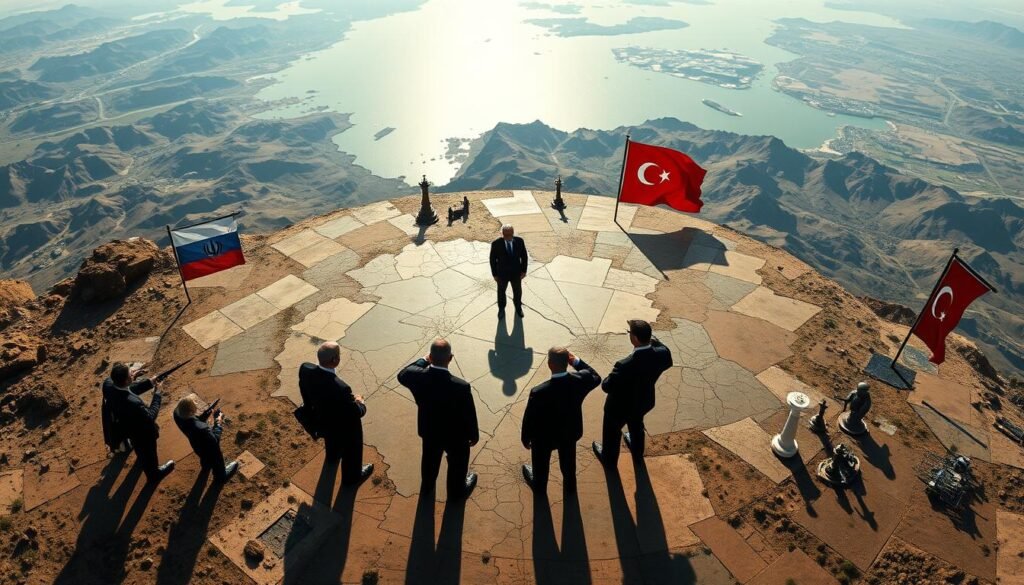
Power balances are changing in the South Caucasus. New trade lanes and security deals are reshaping international relations. These changes affect energy, transit, and risk.
The Middle Corridor and recent diplomatic breakthroughs are key. They intersect with the U.S.-brokered peace in the South Caucasus. This shapes choices from Moscow to Brussels.
Russia’s sidelining and hybrid pushback in Armenia
TRIPP is changing logistics under Armenian control. It narrows space for an FSB-run “Zangezur corridor.” Moscow’s influence is decreasing as Yerevan takes back border posts.
Armenian forces took control at Agarak on December 30, 2024, and at Margara on February 28, 2025. By March 1, 2025, they consolidated entry and exit points. Russian guards are seen along parts of the borders with Türkiye and Iran.
Information warfare is now used by Moscow. Media in Yerevan sees TRIPP as a risk to sovereignty. The U.S.-brokered peace in the South Caucasus sets limits on transit. These moves are part of broader regional realignments.
Iran’s evolving stance and the Araz corridor alternative
Tehran opposed any route that hinted at extraterritorial control or map changes. Later, Foreign Minister Abbas Araghchi said the joint declaration answered core Iranian concerns. The Araz corridor through Iran links Azerbaijan with Nakhchivan, reducing Armenia’s role in east-west flows.
This dual track shapes freight choices and insurance costs along the Middle Corridor. It tests diplomatic breakthroughs as operators weigh tariffs, wait times, and political risk. For Iran, balancing sovereignty language with practical transit gains is key to steady international relations.
Türkiye’s pan-Turanist ambitions and EU’s Middle Corridor
Ankara backs deeper transit across the Turkic world, aligning with Baku’s push for seamless links to Central Asia. This vision folds into the Middle Corridor, where ports from Baku to Aktau set tempo for rail and Ro-Ro schedules. The U.S.-brokered peace in the South Caucasus interacts with these aims by keeping routes commercial and under host-state law.
In Europe, Ursula von der Leyen floated Armenia’s participation in April 2025, which President Ilham Aliyev rejected. Later, von der Leyen and António Costa endorsed Armenia’s “Crossroads of Peace,” signaling EU interest in balanced, sovereignty-respecting access. These signals feed regional realignments as Brussels seeks resilient supply chains without undercutting diplomatic breakthroughs.
| Actor | Primary Objective | Leverage Tool | Connectivity Impact | Relation to Middle Corridor |
|---|---|---|---|---|
| Russia | Preserve influence in Armenia and transit control | Security presence, information ops | Favors bilateral dependence, slower liberalization | Prefers alternatives that keep Yerevan reliant on Moscow |
| Iran | Prevent border changes; gain transit revenue | Araz corridor, customs policy | Offers Azerbaijan–Nakhchivan link via Iranian soil | Serves as complementary or competing route to the corridor |
| Türkiye | Advance pan-Turanist links to Central Asia | Strategic alignment with Azerbaijan, logistics hubs | Accelerates east-west freight and energy flows | Core architect and promoter of overland pathways |
| European Union | Build resilient, rules-based supply chains | Funding, standards, customs cooperation | Encourages diversified routes through the South Caucasus | Backs the Middle Corridor with sovereignty safeguards |
| Armenia | Protect sovereignty; monetize transit | TRIPP, border control, customs parity | Centers commercial traffic under national law | Potential node linking Black Sea and Caspian segments |
| Azerbaijan | Secure direct links to Nakhchivan and Türkiye | Energy exports, strategic partnerships | Strengthens westward freight and energy corridors | Key bridge between Caspian shipping and rail grids |
Armenia’s “Crossroads of Peace” and Connectivity Strategy
Armenia sees its Crossroads of Peace as a way to connect the region legally and safely. It aims to support ongoing peace talks and ensure stable access. Prime Minister Nikol Pashinyan has talked to President Recep Tayyip Erdoğan about the benefits and connections to the Middle Corridor.
Reciprocity, customs parity, and multi-directional access
The policy wants equal customs rules and fees at the border. It starts with cargo routes to build trust, then adds passengers. The goal is to allow shipments in all directions, with clear controls and audits.
TRIPP can help by ensuring reliable schedules without giving up sovereignty. This means synchronized checkpoints and shared risk scoring. It also involves data exchange for compliance and steady trade across the South Caucasus.
Rehabilitating rail links, Meghri’s legacy, and domestic integration
The Meghri stretch shows the cost of delay: the Yerevan–Baku rail collapse in 1992 left steel and bridges to rust. Restoring the corridor needs capital, insurance, and political will. It also requires safety and performance milestones before increasing volumes.
First, rail will be restored, then roads. This will connect Syunik to central Armenia via Nakhchivan and beyond. It will lower costs for miners, agribusiness, and manufacturers, making logistics more stable.
Prospects for Gyumri–Kars and Trans-Caspian connectivity
If the Armenia–Türkiye border reopens, the Gyumri–Kars line could reconnect production hubs to ports. This would extend the Middle Corridor and support stable timetables from the Black Sea to Central Asia.
Progress needs security guarantees, cooperation with Azerbaijan, and clear dispute channels. With these, the Crossroads of Peace could link local industry to wider markets. It would strengthen regional connectivity through fair peace negotiations and responsible international relations.
Domestic Politics and Sovereignty Risks
Armenia’s debate over a U.S.-brokered track is complex. It involves domestic politics, sovereignty risks, and changing international relations. People trust the government when they understand the rules and see that agreements protect their borders and rights.
Constitutional change demands and internal legitimacy
President Ilham Aliyev wants Yerevan to change its constitution. He says this shows Armenia’s claims to Nagorno-Karabakh. But, Armenia’s Constitutional Court says only clear text matters, and the current charter doesn’t mention Artsakh or Nagorno-Karabakh.
Legal experts, like the Lemkin Institute, warn that adding a treaty to these demands could harm peace talks. They say it’s an invasion of Armenia’s internal affairs.
Prime Minister Nikol Pashinyan’s approval is shaky. Long debates over amendments could weaken his position. A clear legal path, based on existing laws, can reduce risks and keep talks going.
Managing disinformation on borders and alleged U.S. military presence
Some say TRIPP would cut Armenia’s border with Iran or bring U.S. troops. These claims come from Azerbaijani media and some in Armenia. But, the joint declaration says Armenia controls its borders and there’s no U.S. troop plan.
It’s important to give accurate updates and facts to stop false information. This helps keep people’s trust as things change and new agreements are made.
Balancing U.S. partnership with EAEU and Russian rail control
Yerevan is tied to the Eurasian Economic Union economically. Russian companies run key rail lines, affecting costs and schedules. Pashinyan notes Moscow wants to reopen lines, but Baku must agree.
It’s important to balance U.S. support with EAEU duties carefully. Clear rules, non-exclusive transit, and gradual rail reopenings can ease tensions and keep relations stable.
| Issue | Core Concern | Mitigation Steps | Stakeholders | Timeline Sensitivity |
|---|---|---|---|---|
| Constitutional Demands | External pressure may delay or derail peace agreements | Rely on Constitutional Court rulings; codify non-claims language in treaty annexes | Government of Armenia, Office of the President of Azerbaijan, Lemkin Institute | High—pre-ratification phase |
| Border Narratives | Disinformation about Iran access and foreign troops | Public briefings, third-party monitoring, synchronized maps and FAQs | Ministry of Foreign Affairs of Armenia, OSCE monitors, local media | High—during implementation |
| Rail Control | Russian-operated assets constrain options | Diversified finance; incremental reopening of Ijevan–Hrazdan/Ijevan–Kazakh pending Baku consent | South Caucasus Railway (Russian Railways), Government of Azerbaijan, Ministry of Territorial Administration of Armenia | Medium—linked to technical audits |
| Trade Bloc Commitments | EAEU rules intersect with new corridors | Customs parity, reciprocity clauses, phased tariff alignment | Eurasian Economic Commission, Ministry of Economy of Armenia, U.S. partners | Medium—phased over 12–24 months |
| Public Legitimacy | Domestic politics skepticism over sovereignty risks | Parliamentary oversight, citizen dashboards, independent audits | National Assembly of Armenia, civil society groups, international observers | High—continuous |
Caspian Realignments and Commercial Stakes
TRIPP connects Armenia to the Caspian, opening new paths for energy and trade. It links U.S. economic goals with regional peace. This turns diplomatic wins into real projects in rail, customs, and services.
U.S. strategic access to Central Asian minerals via TRIPP
TRIPP gives the U.S. a direct route to the Caspian’s minerals. It offers access to uranium, lithium, and rare earths in Kazakhstan and Uzbekistan. The 99-year rights for development attract big investors like Bechtel and Caterpillar.
Investment in Syunik boosts regional stability. It makes customs and data-sharing more reliable. This leads to more trade and less insurance risk.
Comparative lens: Panama Canal analogies and differences
The Panama Canal shows U.S. control over a key route. But TRIPP is different, respecting Armenian sovereignty. It focuses on commercial transit, not defense.
TRIPP uses local laws and joint inspections, unlike the canal. This mix aims to ensure smooth flow without defense duties. It balances access with local consent in the Caspian region.
Private investment, logistics hubs, and informal security assurances
A U.S.–Armenia deal plans to boost infrastructure and border security. It aims to attract private investment. Logistics hubs and rail projects will be managed by a consortium.
Investment in Syunik makes supply chains visible. This creates a security presence, supporting regional stability. It turns diplomatic efforts into steady trade flows.
Risks, Timelines, and Fragility of Implementation

The journey from promises to action is tough. The U.S.-Brokered Peace in the South Caucasus faces many challenges. Clear plans, regular checks, and fair access are key to success in this unstable area.
12–18 month risk window for unraveling
Experts say a 12–18 month window is critical. Unclear laws and vague plans can slow down peace efforts. If deadlines for roads and rails are missed, trust can quickly fade.
Any disagreement over who can inspect or share data can make things worse. Without clear steps to solve problems, parties might turn to force instead of working together.
Border security, monitoring missions, and ceasefire integrity
Border issues test the strength of ceasefire agreements. Armenia’s work with the European Union Monitoring Mission has helped keep things calm. But, if outside help fades before trust grows, peace is at risk.
It’s important for verification to be clear and fast. Keeping records open, coordinating patrols, and using secure communication helps avoid misunderstandings that could lead to bigger problems.
Reciprocity deficits and possible spoiler behavior
Reciprocity is essential. Azerbaijan’s benefits through Armenia under TRIPP need equal guarantees for Armenia’s movement in Azerbaijan. Without this, disputes can arise and harm peace talks.
Spoilers can take advantage of these gaps. They might use preconditions, procedural delays, or false information about U.S. military roles to undermine peace. Hybrid tactics, like spreading false information, can widen small issues into big problems within the U.S.-Brokered Peace in the South Caucasus.
- Operational clarity: Define third-party functions, inspection authorities, and data protocols to limit misinterpretation.
- Phased sequencing: Align rail-road activation with reciprocal access and customs parity to cap implementation risks.
- Responsive oversight: Use rapid review panels to keep ceasefire agreements credible when incidents spike.
Conclusion
The U.S.-brokered framework has changed the South Caucasus map. It replaced an old model with TRIPP, showing U.S. commercial involvement and Armenian sovereignty. This effort led to a joint declaration and a peace text aiming for mutual recognition and trade.
But these agreements are not final until signed and ratified. This means the path to peace is uncertain until all parties agree and meet clear goals.
For lasting peace, gaps in regional stability must be closed. Armenia needs fair transit, ceasefire monitoring, and steps for human security. This includes POW releases and protecting cultural heritage.
Armenia must also ensure its sovereignty is respected. This is key to competing in a crowded market of routes. The success of U.S.-brokered peace depends on this.
The next 12–18 months are critical. A detailed plan for TRIPP, transparent governance, and clear guarantees are needed. These steps can turn diplomatic success into lasting stability.
Success will depend on discipline and proof. Regular audits and public reports can build trust. With these measures, the U.S.-brokered peace can become a reality, securing the region’s future.


