

Blue Energy Revolution: U.S.-Cook Islands Seabed Mining Pact and Pacific Hegemony Rationale.
Only about 5% of the ocean has been explored, yet it underpins roughly $3 trillion in annual economic activity. This paradox sets the stage for a U.S.-Cook Islands pact. It could redefine the Blue Energy Revolution and recast Pacific hegemony in the age of clean power.
This Section 1 frames the agreement as an energy transition case study anchored in law, security, and markets. It links deep-sea minerals to clean energy solutions. It also weighs strategic reach across a vast Exclusive Economic Zone. The focus is practical: how a compact with the Cook Islands could fast-track a blue economy while aligning with U.S. interests and Pacific stability.
Recent history offers a useful lens. New Caledonia’s nickel surge—and its 30% export growth to Asia over five years—shows how critical minerals can reorder trade flows and alliances. In parallel, the European Union’s 2021 Indo-Pacific strategy, France’s military footprint, and ongoing autonomy debates demonstrate why durable agreements must balance sovereignty, investment, and community consent.
The pact’s logic does not exist in a vacuum. Under UNCLOS, EEZs grant control out to 200 nautical miles, enabling regulated access to seabed resources. Yet governance remains patchy as global interest in manganese, cobalt, and nickel intensifies. UNIDIR’s 2024 analysis warns that maritime security risks—from shadow fleets to cable sabotage—are rising, pressing for clearer norms as the Blue Energy Revolution accelerates.
For the United States, a well-structured U.S.-Cook Islands pact could serve as a template. It can offer a measured path to clean energy solutions, transparent oversight, and supply resilience. If crafted with environmental guardrails and local agency, it can support the blue economy while advancing a wider Pacific hegemony strategy rooted in rules, trust, and shared prosperity.
Key Takeaways
- Less than 5% of the ocean is explored, yet it drives about $3 trillion in annual activity, underscoring the stakes of seabed policy.
- A U.S.-Cook Islands pact can become an energy transition case study linking critical minerals to clean energy solutions and supply security.
- New Caledonia’s nickel growth shows how Pacific minerals reshape trade routes and influence Pacific hegemony.
- UNCLOS and EEZ rules provide a legal base, but fragmented governance calls for clearer standards and coordinated oversight.
- UNIDIR highlights rising maritime risks, making security and resilience central to any blue economy strategy.
- A pact designed with community consent and environmental safeguards can align national interests with regional stability.
Executive Overview: Why a U.S.-Cook Islands Seabed Mining Pact Matters for the Energy Transition
The Cook Islands are home to one of the Pacific’s most valuable resources: polymetallic nodules. A partnership with the United States would align their economic rights with global demand for essential minerals. This synergy is critical for the energy transition, as clean energy solutions depend on consistent mineral supplies.
This agreement would merge ocean conservation with industrial strategy. It aligns with the blue economy, shaping maritime infrastructure and research collaborations. This approach paves the way for sustainable technology, scalable within a structured framework.
Clean energy solutions, supply security, and strategic depth
Electric vehicles, grid storage, and offshore wind require consistent access to cathode materials. A U.S.-Cook Islands pact could establish stable offtakes and contracts, reducing price volatility. It would enhance supply security and strategic depth across the Pacific.
Security and sustainability rise together when critical infrastructure is safeguarded. This strategy supports U.S. Navy and Coast Guard efforts, bolstering clean energy resilience.
Critical minerals from the seabed and a carbon-neutral future
Seabed nodules hold concentrated nickel, cobalt, copper, and manganese, ideal for battery refining. As terrestrial sources dwindle, offshore mining can provide essential inputs for cathode plants. This approach supports a carbon-neutral future while protecting deep-sea ecosystems.
Success hinges on responsible extraction, including baseline mapping and waste reduction. These efforts align mineral extraction with sustainable technology goals, overcoming energy transition hurdles.
Blue economy linkages to U.S. industrial policy
The pact links the blue economy to U.S. funding mechanisms, driving domestic processing and workforce development. It promotes port upgrades and shortens the path from exploration to refining. Transparent royalties and benefit-sharing ensure local value creation while meeting U.S. supply goals.
By harmonizing standards with UNCLOS and regional forums, the pact fosters interoperability among allies. This cooperation bolsters investment confidence, ensuring clean energy solutions meet the demands of a carbon-neutral future.
Geopolitical Context: Pacific Hegemony, Great-Power Competition, and the Blue Economy
Sea lanes, data cables, and mineral frontiers now shape power in the Pacific. As trade shifts and climate pressure mounts, the blue economy links supply chains with security. Policymakers use an Indo-Pacific strategy to steer access, standards, and investment tied to renewable energy.
Margins have become the map’s center. Exclusive Economic Zones turn distant waters into national interests, and that raises the stakes of Pacific hegemony. Governance gaps at sea invite friction, while coastal states seek jobs and resilience without losing control.
Indo-Pacific dynamics: margins becoming the focal point
The European Union’s 2021 Indo-Pacific approach spotlighted Pacific Islands as hubs for routes, data, and critical minerals. France’s forces in New Caledonia add presence that intersects with U.S. patrols and regional coast guards. This visibility tightens great-power competition around sea lines and seabed resources linked to renewable energy.
Fisheries, subsea cables, and offshore minerals concentrate value. As the blue economy grows, UN bodies warn of a “blue acceleration,” with more ships, platforms, and sensors at sea. That surge makes coordination essential to reduce risk while aligning with an Indo-Pacific strategy.
U.S.-EU strategic alignment and autonomy tensions
Washington and Brussels often align on supply security, maritime law, and clean-tech standards. Yet debates over strategic autonomy shape how fast they move together on financing, export controls, and data-sharing. Harmonizing screening for critical inputs can steady the blue economy while supporting renewable energy targets.
New Caledonia’s role illustrates this balance. French assets provide reach, but local politics and environmental safeguards set pace and scope. Common benchmarks on monitoring and due diligence help manage Pacific hegemony concerns without sidelining island priorities.
China’s Pacific engagement and regional responses
China’s infrastructure lending, port projects, and fisheries deals widen its maritime footprint. Some island governments welcome capital; others stress transparency, debt terms, and ecological care. This mixed response reflects agency amid great-power competition and a drive to shield the blue economy from shocks.
Regional forums, from the Pacific Islands Forum to subregional groups, test new guardrails for investment and ocean use. Their choices will influence how an Indo-Pacific strategy supports sovereign development, clean industry, and reliable inputs for renewable energy.
| Driver | Stakeholders | Impacts on Blue Economy | Security Considerations |
|---|---|---|---|
| Trade routes and subsea cables | U.S., EU, Japan, Australia, Pacific Islands | Faster data, resilient logistics, service exports | Cable protection, patrol capacity, incident response |
| Critical minerals and seabed access | Cook Islands, France (New Caledonia), private firms | Battery inputs for renewable energy, new revenues | Licensing integrity, monitoring, ESG verification |
| Finance and infrastructure diplomacy | China, multilateral banks, U.S.-EU initiatives | Ports, energy hubs, local jobs | Debt risks, dual-use assets, port security |
| Climate resilience and fisheries | Pacific Islands Forum, NOAA, FAO | Food security, sustainable value chains | Illegal fishing, MDA tools, cooperative enforcement |
| Standards and technology | IEC, ISO, U.S.-EU Trade and Technology Council | Interoperable systems, export growth | Supply integrity, data governance, compliance |
Legal and Governance Frame: UNCLOS, EEZs, and Seabed Rights in the Cook Islands
The Cook Islands are at the forefront of ocean governance. UNCLOS outlines who can explore, who must protect, and how benefits should be distributed. A harmonized national law with regional norms can establish a solid foundation for cooperation and trust.
How EEZs enable national control over marine resources
The Exclusive Economic Zone (EEZ) extends 200 nautical miles from the shore. It grants the Cook Islands full rights to develop marine resources. This includes living stocks and minerals, such as nodule fields with strategic metals. UNCLOS ensures that the state can manage access while aligning with local interests.
New Caledonia’s experience highlights the importance of legal frameworks and consent. French sovereignty, autonomy, and EU norms have ensured resource use aligns with community oversight. Similar principles apply to the Cook Islands, supporting benefit-sharing and rigorous science in their EEZ.
Licensing, environmental due diligence, and emerging norms
Licensing must be tied to verifiable data and clear standards. Environmental due diligence begins with baseline mapping and defines critical points for review or redesign. This mirrors U.S. debates on balancing seabed mining regulation with public interests.
Hydrothermal vents and deep benthic habitats are highly sensitive. Continuous monitoring and independent audits are essential. Permits that link milestones to environmental impact findings provide clarity for investors and protection for communities.
Patchwork governance risks and calls for UN coordination
A disjointed regulatory landscape increases costs and weakens compliance. UNIDIR advocates for UNCLOS refinement and stronger regional mechanisms. The IMO, FAO, UNEP, UNODC, and IOM should play key roles. Aligning Cook Islands policies with these bodies reduces duplication and fills gaps.
Standardized regulations ensure consistency across the Pacific. When seabed mining, environmental due diligence, and enforcement are aligned, investment can grow while meeting ocean governance expectations.
Resource Logic: Polymetallic Nodules, Nickel, Cobalt, and Renewable Energy Supply Chains

Polymetallic nodules, abundant in nickel, cobalt, manganese, and copper, lie on the Pacific seafloor. These deposits are foundational to the supply chains that fuel renewable energy growth in the United States. As demand for batteries and grid storage increases, focus shifts to critical minerals. These minerals are essential for scaling sustainable technology without the risks associated with fragile sourcing.
Why seabed minerals matter for batteries and sustainable technology
Electric vehicle (EV) packs from Tesla, General Motors, and Ford depend on nickel and cobalt to enhance energy density. Grid-scale systems from Fluence and Tesla Megapack require long-lasting performance and stable output. Seabed nodules, with their dense, multi-metal composition, could diversify critical minerals. This is vital for supporting eco-friendly power when terrestrial supplies are limited.
Despite covering less than five percent of the ocean, exploration is ongoing. Any path forward must align with sustainable technology goals. This includes low-carbon processing and verified traceability. Such alignment is critical for maintaining credibility with investors and the public.
Lessons from New Caledonia’s nickel for green innovation
New Caledonia’s nickel exemplifies how a single resource can influence trade balances and politics. Price fluctuations and community impacts underscore the need for planning against volatility and social risks. Industry leaders must adopt transparent contracts, uphold strong labor standards, and ensure community benefit sharing to avoid boom-bust cycles in green innovation.
Refining routes also play a significant role. Lower-emission processing and clean power inputs reduce the environmental footprint of battery metals. When combined with recycling, these measures mitigate exposure to price shocks. This ensures a steady flow of critical minerals to renewable energy manufacturers.
Balancing eco-friendly power with extraction externalities
Seabed mining must be monitored for noise, sediment plumes, and biodiversity impacts. Independent monitoring, clear thresholds, adaptive management, and public reporting are essential for legitimacy as eco-friendly power expands. Supply chain security—vessels, ports, and subsea links—must integrate with environmental safeguards to maintain trust in green innovation.
Diversified portfolios, combining seabed sources, responsible terrestrial mining, and closed-loop recycling, can meet demand for critical minerals. This approach aligns with sustainable technology principles, driving the energy transition forward.
Blue Energy Revolution
The Blue Energy Revolution is redirecting focus from the center to the ocean margins. Island governments and coastal communities are now making key decisions on minerals, fisheries, and climate. This shift emphasizes local agency and autonomy, blending science with practical agreements that support the energy transition while preserving stewardship.
Oceans play a critical role in driving global trade, regulating heat, and hosting biodiversity essential for food and jobs. Within exclusive economic zones, access to these resources comes with responsibilities. Blue economy leadership must balance revenue generation with environmental protection. This balance is essential for a clean energy industrial policy that values data, monitoring, and community involvement.
Security is now a fundamental aspect of the Blue Energy Revolution. Integrated maritime awareness, resilient ports, and protected subsea routes are necessary for scaling clean materials and offshore power. These measures ensure steady investment while allowing for flexibility and adaptive rules as technologies evolve.
Deep-sea minerals hold promise for battery and grid inputs, yet the ecosystems beneath are challenging to map. A cautious approach advocates for phased pilots, transparent sampling, and public benchmarks. This approach keeps the energy transition on track while safeguarding future scientific and economic opportunities.
| Pillar | Practical Focus | Public Value | Policy Signal |
|---|---|---|---|
| Governance | Clear EEZ rules, open licensing, impact baselines | Trust and legitimacy for shared waters | Stronger blue economy leadership |
| Science | Seafloor mapping, biodiversity surveys, open data | Evidence for low-risk scaling | Adaptive clean energy industrial policy |
| Security | Maritime domain awareness, cable and port resilience | Stable flows of critical materials | Risk-informed investment in the energy transition |
| Community | Benefit-sharing, labor standards, cultural respect | Local agency and durable outcomes | Social license for the Blue Energy Revolution |
Security Lens: Maritime Security, Seabed Infrastructure, and Emerging Risks
The blue economy thrives only when sea lanes, seabed assets, and data links are secure. Maritime security now encompasses hard patrols, quiet sensors, and legal deterrents against covert activities. The U.S., France, and Australia maintain a regional presence, while partners enhance maritime domain awareness.
Protecting subsea cables, mining vessels, and shadow fleets
Subsea cables, carrying most global internet traffic, are critical. A disruption can impact markets and ports significantly. Protecting these routes near the Cook Islands requires detailed charts, patrol patterns, and swift repair plans with companies like SubCom and Alcatel Submarine Networks.
Mining vessels face similar challenges, needing escorts, AIS integrity checks, and clear protocols for port calls. These measures help deter gray-zone threats and shadow fleets.
Hydrographic mapping exercises paired with uncrewed surface vessels reduce blind spots. Simple measures, such as maintaining spare cable stockpiles, conducting joint incident drills, and sharing drydock access, minimize downtime after incidents.
Blue crimes, sanction evasion, and maritime domain awareness
Illegal fishing, fuel smuggling, and sanction evasion often involve spoofed IDs and dark transits. Maritime domain awareness improves with satellite AIS, SAR imagery, and commercial RF mapping. These tools provide a unified picture for coast guards and telecom operators.
Data fusion identifies ship-to-ship transfers near EEZ edges and unusual loitering over cable crossings. Clear playbooks guide responses to anomalies, involving patrol aircraft, port state controls, and insurance freezes until risk assessments are complete. Insurers and classification societies like Lloyd’s Register reinforce this by linking coverage to verified transparency.
UNIDIR guidance on future sea security challenges
Recent UN Institute for Disarmament Research guidance highlights rising risks: attacks on merchant shipping, sea mines, maritime cyberattacks, and subsea cable vulnerabilities. It also addresses AI-enabled and autonomous vessels, new sensor standards, and seabed activity disputes.
Regional seas strategies, shared threat baselines, and a coordinated UN approach align with efforts by the European Union and the Pacific Islands Forum. Together, they enhance maritime security, reducing opportunities for shadow fleets and sanction evasion.
Environmental Stakes: Ocean Acidification, Biodiversity, and Deep-Sea Ecosystem Integrity
The Pacific deal emerges against a backdrop of increasing ocean acidification and biodiversity stress. Any seabed activities must consider these impacts on deep-sea ecosystems. They must also support a clean energy transition that communities can rely on.
Scientific uncertainty around hydrothermal vent communities
Hydrothermal vents are home to unique life forms that depend on chemical reactions, not sunlight. Scientists warn that species near vents are often localized. Recovery from disturbances can be slow.
Efforts to map and study these areas are underway. Baseline mapping, careful sampling, and time-series studies aim to reduce uncertainties. Yet, gaps persist, including in the water column and seabed. These gaps include understanding larval drift, plume behavior, and food-web links within deep-sea ecosystems.
Pollution spillovers from attacks or accidents at sea
Incidents at sea can lead to widespread pollution, affecting large areas. Oil, metals, and soot can settle in sediments. They can then be carried by currents into sensitive zones, exacerbating ocean acidification and eroding biodiversity.
Strategies to mitigate these risks include stronger routing, vessel hardening, and rapid-response booms. Integrated maritime security and environmental protocols can also help curb cross-border pollution threats to deep-sea ecosystems.
Securing 30×30 goals while enabling energy transition
The 30×30 marine protection vision aims to establish durable reserves. At the same time, the clean energy transition requires reliable access to minerals and routes. It is essential to have transparent rules, credible monitoring, and clear triggers for pause-or-proceed decisions.
Marine protected areas that align with migratory corridors, vent fields, and nursery grounds can safeguard biodiversity. Strategic siting and adaptive management are key. They ensure 30×30 marine protection goals are met while supporting a resilient supply chain.
| Priority | Why It Matters | Key Actions | Environmental Focus | Vent Baselines |
|---|---|---|---|---|
| Uncertainty around rare species and habitat functions | Long-term observatories, plume modeling, genetic sampling | Deep-sea ecosystems integrity | ||
| Spill Preparedness | ||||
| Accidents or attacks can trigger regional pollution | Resilient routing, rapid response, joint drills | Limits compounding effects with ocean acidification | ||
| Protected Network | ||||
| 30×30 marine protection targets need effective coverage | Representative MPAs, enforcement tech, adaptive rules | Safeguards biodiversity under traffic and extraction | ||
| Transition Alignment | ||||
| Mineral demand must fit with public trust and science | Transparent data, phased milestones, independent review | Balances clean energy transition with ecological limits |
Regional Case Signal: New Caledonia’s Strategic Minerals and EU’s Indo-Pacific Recalibration
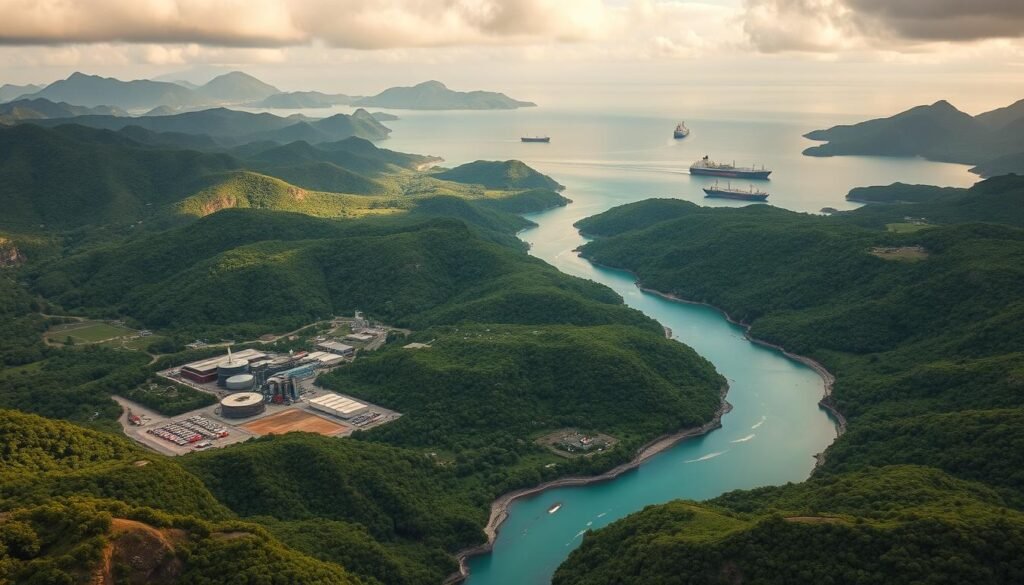
New Caledonia is at the intersection of resource policy and ocean strategy. Its rich nickel reserves, expansive EEZ, and French ties make it central to the EU Indo-Pacific dialogue. Here, strategic minerals and maritime standards influence trade, defense, and climate objectives.
Nickel dependence, autonomy debates, and stability risks
Nickel is key to local employment and exports to Asia, but this dependence can lead to price volatility and social tensions. The 1853 annexation, the 1998 Nouméa Accord, and recent independence votes shape debates on autonomy. These discussions impact investor confidence and the efficiency of port operations.
France’s military presence and patrols ensure safe trade routes, but community trust is conditional on equitable revenue distribution and transparent mining practices. This balance influences the reliability of output and the pace of green innovation in battery supply chains.
EU’s rules-based aims and Pacific Islands engagement
The EU Indo-Pacific strategy emphasizes a rules-based order, climate action, and partnerships with Pacific Island nations. For New Caledonia, this entails aligning regulations on due diligence, labor, and environmental standards across its EEZ.
Collaboration with the Pacific Islands Forum and French forces can harmonize exercises, port visits, and data exchange. This supports supply resilience without neglecting local interests.
Geo-economics shaping supply resilience
Fluctuations in nickel prices, refinery demand, and battery chemistry influence the value of strategic minerals. Harmonized standards on traceability and emissions scoring encourage the purchase of cleaner ore and greener processing.
When maritime security, stable licensing, and community engagement are aligned, New Caledonia can serve as a cornerstone for diversified sourcing in the EU Indo-Pacific market. This fosters green innovation with fewer obstacles.
Allies and Partners: Australia’s Strategy, Pacific Islands Forum Dynamics, and Local Agency
Canberra’s role as a preferred partner is central to its Pacific strategy. It emphasizes security and aid, but the Pacific Islands Forum tests its commitment. The focus must be on aligning with island priorities, such as climate resilience and equitable ocean economies.
Aid, climate credibility, and “preferred partner” narratives
Australia increases funding for grants, patrol boats, and infrastructure. Yet, its coal exports undermine its climate credibility. Partnerships that support methane reduction, resilient grids, and disaster finance gain trust. Blue economy partnerships focusing on local value chains, from fisheries to seabed standards, can solidify lasting relationships.
Pacific priorities: climate resilience over great-power framing
Island governments prioritize sea-level rise, coastal protection, and food security. In the Pacific Islands Forum, they advocate for adaptation before defense. Deals that respect EEZ sovereignty and direct revenue to village services enhance local agency and consent for cross-border projects.
Co-production of standards with island governments
Collaborative rulemaking with ministries and councils sets the pace. Co-authored impact baselines, transparent data, and human rights at sea ensure monitoring. This approach integrates the Australia Pacific strategy with local agency, expanding blue economy partnerships while preserving culture and livelihoods.
- Finance that rewards climate resilience outcomes, not inputs.
- Shared oversight units staffed by island regulators.
- Open data on marine health to inform Pacific Islands Forum reviews.
Designing with, not for, the Pacific enhances standards’ reach. Co-production fosters legitimacy and keeps blue economy partnerships grounded in community verification and adjustment.
Economic Upside: Jobs, Investment, and the U.S. Blue Economy

The ocean economy is growing rapidly, with clear rules guiding U.S. investment towards creating jobs and building resilient supply chains. Modern port infrastructure is also a focus. When agencies align permits with safeguards, capital shifts from pilots to plants. This unlocks sustainable innovation across coastal hubs.
From exploration to operations: value-chain opportunities
Exploration sparks the creation of data science roles, vessel crews, and survey work in the blue economy. As projects progress, fabrication yards in places like Mississippi and Louisiana add subsea hardware and autonomous systems assembly.
Operations then expand into maintenance, metallurgy, and battery precursor processing near ports. Workforce pipelines with community colleges and the Maritime Administration keep apprenticeships aligned with real logistics needs.
Financing models for sustainable blue innovation
Blended finance—combining Development Finance Corporation tools, municipal bonds, and private equity—can de-risk first-of-a-kind assets. Insurance linked to environmental performance and cyber coverage lowers the cost of capital for sustainable innovation.
Green banks in states such as New York can anchor credit lines, while export credit agencies crowd in suppliers for sensors, power systems, and vessel retrofits. Term sheets should include social license clauses and climate resilience covenants.
Trade routes, logistics, and port upgrades
Mineral flows reshuffle shipping lanes, raising demand for dredging, cold ironing, and shore power across key port infrastructure from Long Beach to Savannah. Customs pre-clearance and digital manifests reduce dwell time and boost logistics reliability.
Resilient design—elevated wharves, microgrids, and stronger breakwaters—keeps cargo moving during storms. Secure berths and protected data backbones support subsea cables, RORO traffic, and specialized carriers.
| Growth Driver | Jobs Impact | Capital Sources | Key Enablers | Blue Economy Outcome |
|---|---|---|---|---|
| Seabed survey and mapping | Data analysts, ROV pilots, vessel crews | U.S. investment funds, university consortia grants | EEZ certainty, environmental baselines | Higher-quality resource models and safer operations |
| Processing and midstream build-out | Metallurgy techs, plant operators, electricians | Blended finance, green banks, tax credits | Permitting clarity, grid interconnects | Sustainable innovation in battery precursors |
| Port modernization | Dockworkers, engineers, cybersecurity staff | Municipal bonds, private equity, federal grants | Shore power, digital twins, resilient port infrastructure | Faster logistics and lower emissions |
| Secure trade routes | MDA analysts, insurance underwriters, compliance teams | Reinsurance, export credit, maritime lenders | Maritime domain awareness, cyber protections | Reliable shipping and reduced risk premiums |
Risk Management: Environmental Safeguards, Monitoring, and Adaptive Regulation
Effective ocean policy relies on accurate data and trust. It involves strong environmental safeguards, clear monitoring rules, and adaptive regulation. These elements guide investment while protecting biodiversity and climate functions. The goal is to integrate sustainable technology with oversight that communities can verify.
Baseline mapping and cumulative impact assessment
Only a small part of the ocean has been mapped in detail. Baseline studies are essential. They include high-resolution seafloor mapping, water-column chemistry, and species inventories. A cumulative impact assessment then tracks how activities interact over time.
Precaution is key near hydrothermal vents and sensitive habitats. Agencies can stage permits and require phased sampling. They also insist on open data to support transparency. When findings change, adaptive regulation can adjust limits or pause work without derailing sustainable technology goals.
MDA, sensors, and autonomous systems for compliance
Modern maritime domain awareness combines satellite AIS, radar, acoustic arrays, and seabed loggers. Networked sensors feed dashboards for real-time monitoring and compliance. Cyber-hardened data paths reduce spoofing and gaps.
Autonomous systems extend patrol reach and cut costs. They document turbidity plumes, sound levels, and benthic disturbance. Standards from groups like UNIDIR inform risk checks for critical infrastructure and digital controls.
Transparency, data-sharing, and community oversight
Public dashboards and plain-language summaries raise transparency and trust. Licensing can require raw sensor feeds and verified logs. Audits by universities or national labs like NOAA and the U.S. Geological Survey ensure accuracy.
Community oversight boards and regional forums can co-design thresholds and alerts. Clear benefit-sharing and accessible grievance channels align monitoring with local expectations. This signals that sustainable technology proceeds with social license.
| Risk Focus | Required Evidence | Tools and Methods | Governance Action | Stakeholder Role |
|---|---|---|---|---|
| Habitat disturbance | Baseline species maps; sediment profiles | Multibeam sonar; ROV transects; eDNA sampling | Adaptive buffers; phased permits; seasonal limits | Universities validate surveys; fishers report anomalies |
| Water quality and plumes | Turbidity, metals, and noise thresholds | Autonomous systems with turbidity sensors; hydrophones | Real-time alerts; automatic slowdowns and stand-downs | Community boards monitor dashboards; NGOs verify logs |
| Cyber and data integrity | Tamper-evident records; audit trails | Encrypted telemetry; mirrored black boxes; AIS cross-checks | Mandatory incident reporting; rapid patch protocols | Independent auditors test controls; regulators enforce |
| Cumulative impacts | Long-series time trends across sites | Cloud analytics; satellite time-lapse; standardized metadata | Threshold-based caps; periodic rule reviews | Regional forums set criteria; agencies coordinate |
| Social license and benefits | Transparent royalties; local hiring metrics | Public ledgers; accessible reports; grievance trackers | Binding benefit-sharing; renewal tied to performance | Island governments co-design terms; citizens provide feedback |
Lawfare and Norms: Clarifying Rules for Seabed Mining and Security

The future of ocean governance hinges on establishing clear guidelines to prevent lawfare and enhance maritime security. The European Union’s Indo-Pacific strategy and France’s leadership in New Caledonia demonstrate the importance of a coherent framework. Such a framework is essential for a rules-based order that both industry and coastal communities can rely on.
The United Nations Institute for Disarmament Research highlights the need to address the ambiguity at sea. Civil vessels can disguise their military intentions, posing a threat to seabed operations. This situation emphasizes the urgency of refining UNCLOS to address cyber threats, seabed mining disputes, and critical infrastructure protection.
In the exclusive economic zones, U.S. policy discussions underscore the necessity for clear mandates, joint enforcement, and transparent licensing. The absence of clear roles allows illicit actors to exploit loopholes. Establishing clear maritime security laws, coupled with real-time monitoring and open data, is vital. It ensures the alignment of security, commerce, and environmental protection.
A balanced approach combines national efforts with international cooperation. Pacific Island nations seek predictability and respect for their consent. Operators require stable permits and rigorous due diligence. A high-level UN panel could expedite UNCLOS refinement and seabed mining norms, fostering innovation and community protection.
Key priorities converge: reduce coercive ambiguity, uphold a rules-based order, and create credible avenues to settle seabed disputes before they escalate at sea.
Climate Imperative: Aligning Seabed Mining with a Carbon-Neutral Future
Any agreement on deep-sea minerals must align with a carbon-neutral future, not hinder it. It’s essential to measure real climate benefits, safeguard Pacific ecosystems, and match extraction with proven alternatives. The U.S. can align with the European Union’s climate-first approach while respecting island nations’ needs for resilient infrastructure.
Life-cycle accounting for battery minerals
Initiating any project requires a thorough life-cycle analysis. This includes surveying, lifting, processing, shipping, and end-of-life stages. It’s vital to have clear, comparable data for each step.
Tracking greenhouse gases, habitat disturbance, and water use per kilowatt-hour stored is key. Independent labs should verify these benchmarks, ensuring transparency and guiding investment decisions.
Alternative pathways: recycling, substitution, demand efficiency
Before expanding extraction, focus on recycling and substitution to reduce primary demand. Companies like Ford and General Motors are designing battery packs for second life and easier recovery.
Advances in material science from Umicore and Redwood Materials are making high-yield cathode recovery more efficient. Combining these with demand efficiency—such as right-sized batteries and smarter grids—gives us time to gather better evidence.
Green defense and resilient offshore energy infrastructure
As wind farms, cables, and platforms expand, green defense becomes a critical mission. The U.S. Navy and Coast Guard can protect these assets from cyber and kinetic threats while ensuring environmental security at sea.
Resilience involves using layered sensors, encrypted controls, and rapid-repair logistics. It also means designing energy infrastructure that can withstand stronger storms and saltwater corrosion across the Pacific.
| Priority | Action | Climate Rationale | Key Metric |
|---|---|---|---|
| Transparent Footprint | Life-cycle analysis across exploration, processing, and logistics | Aligns mineral supply with a carbon-neutral future | gCO2e/kWh stored; % data third-party verified |
| Demand Moderation | Scale recycling and substitution with design-for-reuse | Delays new extraction and lowers cumulative emissions | % critical minerals from recycling and substitution |
| Asset Protection | Green defense for offshore wind, cables, and hubs | Reduces disruption risk to clean power at sea | Mean time to recovery; incident rate per asset-year |
| Storm Hardening | Build resilient energy infrastructure with redundancy | Maintains supply during extreme weather | Uptime during Category 3+ events; redundancy index |
Communities and Human Security: Indigenous Rights, Labor Standards, and Benefit Sharing
The U.S.–Cook Islands pact will be judged by its impact on people on shore. It must prioritize human security, respect indigenous rights, and establish clear labor standards. Community benefit sharing should be integral to contracts, budgets, and timelines from the outset.
The Pacific offers valuable lessons. The Nouméa Accord in New Caledonia demonstrates the importance of cultural identity and equitable development in building legitimacy. The Pacific Islands Forum’s focus on climate resilience highlights the need for durable consent, with fisheries playing a critical role in food security.
Trust follows practice, not promises. This means transparent revenue rules, worker safety plans, and grievance channels without fear. Early cultural mapping is also essential to protect sacred sites and coastal livelihoods.
Equitable agreements with Pacific island stakeholders
Agreements must be co-designed with elected leaders, traditional councils, and women’s networks. Free, prior, and informed consent requires more than a meeting. It demands readable contracts, local-language briefings, and realistic timelines.
Revenue formulas should link community benefit sharing to milestones in health, education, and climate adaptation. Independent audits and public dashboards are essential to maintain confidence across election cycles.
Human rights at sea and workforce protections
Strong labor standards on vessels and at ports are non-negotiable. Certification, fair pay, rest hours, and medical care reduce risk and increase performance. Whistleblower protections and hotlines on ships strengthen accountability.
Training with maritime unions and local colleges can build a skilled Pacific workforce. Human rights at sea must extend to contractors, including safety drills, harassment prevention, and insurance for families.
Cultural heritage, fisheries, and coastal livelihoods
Baseline studies should map heritage zones and spawning grounds before activity begins. Where uncertainty is high, precautionary buffers protect fisheries and tourism.
Adaptive monitoring can adjust operations to seasonal patterns and storm cycles. If impacts occur, rapid compensation tied to verified catch losses and reef damage helps stabilize household income while ecosystems recover.
- Embed human security goals in every permit and performance bond.
- Honor indigenous rights through standing councils with veto power on heritage risks.
- Enforce labor standards with third-party inspections and public reporting.
- Protect fisheries with science-based limits and real-time monitoring.
- Guarantee community benefit sharing through transparent, ring-fenced funds.
Policy Roadmap: U.S. Strategy to Pair Clean Energy Leadership with Ocean Stewardship
The U.S. strategy should link climate goals with ocean stewardship, using clear rules and shared science. It can set measurable milestones, align with partners in the Pacific, and protect supply chains without sacrificing marine health.
Standards-first approach with UN and regional bodies
A standards-first pact can anchor cooperation with the Cook Islands while respecting its EEZ and local priorities. Build on programs led by the International Maritime Organization, the Food and Agriculture Organization, the United Nations Environment Programme, the United Nations Office on Drugs and Crime, and the International Organization for Migration. This will knit security, labor, and ecology into one framework.
Adopt UN Institute for Disarmament Research guidance to bolster maritime security. Update UNCLOS for seabed and cyber risks. Support regional seas conventions. Pair these steps with transparent data and baseline mapping to keep trust high and decisions evidence-based.
Strategic mineral stockpiles and diversified sourcing
Use strategic mineral stockpiles to smooth shocks while recycling scales. Diversified sourcing across allies lowers risk and prevents dependence on any single node.
Demand management matters too: design incentives that stretch nickel and cobalt through better cathode chemistries and reuse. Align procurement with fair labor, verified traceability, and community benefit-sharing drawn from lessons in New Caledonia.
R&D for low-impact mining and robust recycling
Target low-impact mining R&D to reduce sediment plumes, noise, and fuel use. Back sensors, autonomous systems, and cumulative impact tools that track effects in real time and inform adaptive rules.
At the same time, scale robust recycling so recovered metals feed battery and grid markets. Connect universities, the National Science Foundation, the Department of Energy, and firms like Tesla, Ford, and Redwood Materials to speed pilots from lab to port operations.
| Policy Lever | Primary Goal | Lead Partners | Ocean Safeguard | Supply Impact |
|---|---|---|---|---|
| Standards-first pact | Common rules across security, labor, and environment | Cook Islands, IMO, UNEP, FAO, UNODC, IOM | Baseline mapping and transparent monitoring | Predictable permits and lower compliance risk |
| Diversified sourcing | Reduce single-point dependence | United States, Australia, European Union, Japan | Stronger traceability and EEZ respect | Resilient inflows for battery minerals |
| Strategic stockpiles | Buffer demand spikes and shocks | U.S. Department of Energy, Department of Defense | Time for science-led assessments | Stable prices and planning horizons |
| Low-impact mining R&D | Cut ecological footprint at sea | NSF, NOAA, universities, industry consortia | Plume control, quiet operations, fuel efficiency | Faster project approval with lower risk |
| Recycling scale-up | Close the loop on critical minerals | Redwood Materials, Li-Cycle, Tesla, Ford | Less extraction pressure on habitats | Secondary supply for batteries and grids |
Together, these steps align a credible U.S. strategy with ocean stewardship, using a standards-first mindset, diversified sourcing, and low-impact mining R&D to keep the Pacific both productive and protected.
Conclusion
The Pacific has evolved from a marginal zone to a central pivot for a new era. A U.S.–Cook Islands seabed framework can propel the Blue Energy Revolution forward. This is contingent upon the harmonious progression of sovereignty, climate objectives, and equitable development. New Caledonia’s stance on nickel and the European Union’s reevaluation underscore the importance of strategic minerals in green innovation. This is achieved through community consent and the establishment of stable rules.
Island states now wield significant influence through their Exclusive Economic Zones. Yet, the deep sea demands caution. Science-driven mapping, baseline studies, and adaptive oversight are essential for balancing growth with stewardship. If the pact ensures habitat protection and verifies environmental impacts, it can fuel sustainable technology without incurring ecological costs. This approach integrates development with ocean conservation.
Maritime security has evolved into a critical strategic infrastructure. UNIDIR advocates for risk assessments, unified UN coordination, and refined norms to meet this challenge. This includes safeguarding seabed supply chains, subsea cables, and crews, while elevating maritime security standards across the region. A U.S. approach prioritizing standards, in alignment with allies and Pacific leadership, can effectively deter gray-zone threats and maintain open trade routes.
The future course is clear and focused: implement transparent licensing, invest in low-impact technologies, and combine recycling with diversified sourcing. By doing so, the Blue Energy Revolution can support a carbon-neutral future. It will anchor a resilient rules-based order and expedite the energy transition, with sustainable technology at its core.


